


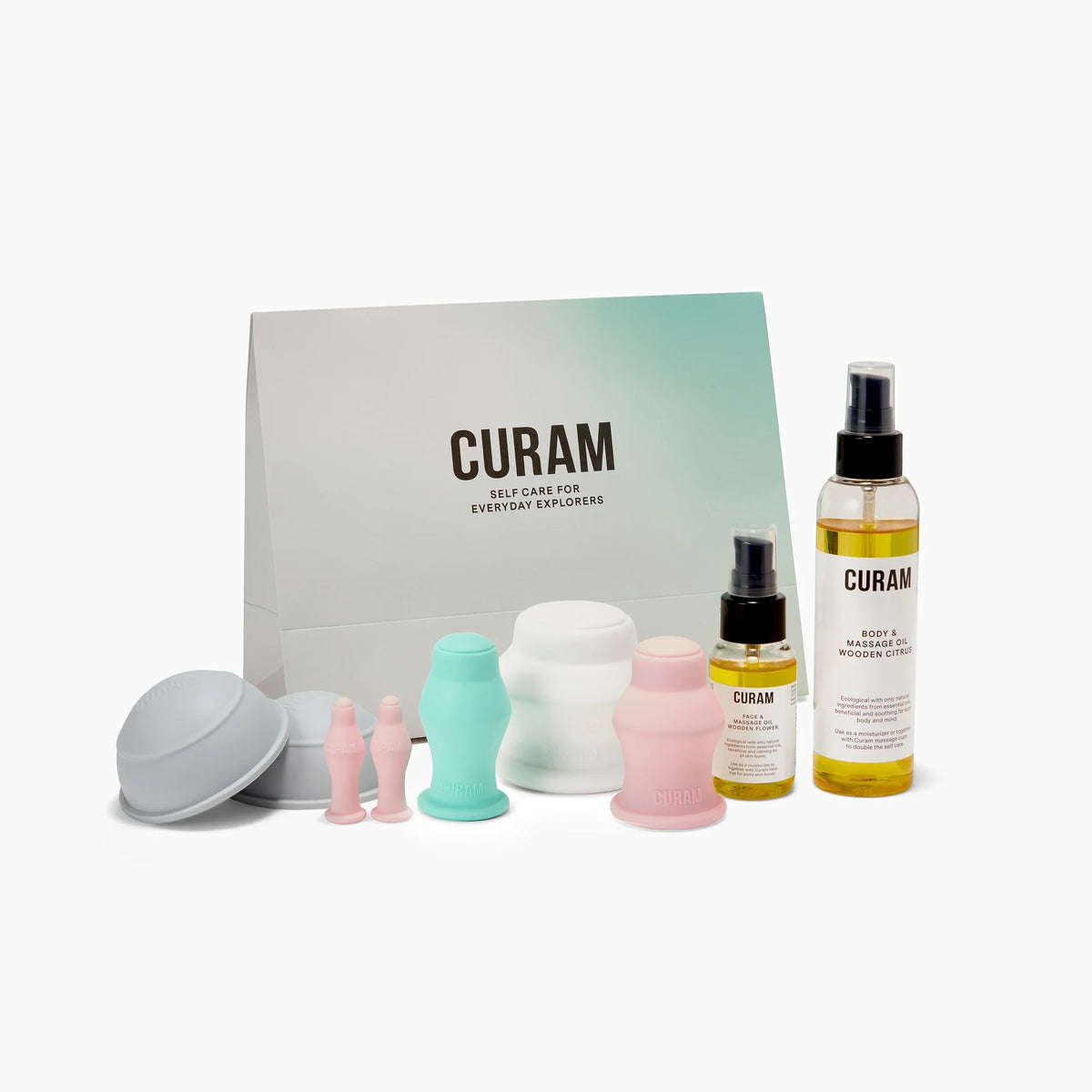
Cupping is a method where a cup placed on the skin creates a vacuum that lifts the skin and the connective tissue underneath. It increases local blood flow, supports lymphatic flow and loosens tight fascia, which is why it is used for muscle tension, recovery after training, circulation and skin. Traditionally done with glass cups and a flame by a practitioner, it is now easy to do at home with soft silicone cups that you squeeze by hand. This guide covers what cupping is, how it works, what it is good for, the different types, what the marks mean, who should avoid it, what research says and how to start.
What is cupping?
Cupping means placing a cup against the skin and creating negative pressure inside it, so that the skin and the tissue beneath are drawn up into the cup. It is essentially reverse massage: where ordinary massage presses down into the tissue, the cup lifts it up and out.
The method is several thousand years old and documented in Chinese, Egyptian, Greek and Middle Eastern medicine. In traditional Chinese medicine (TCM) it sits alongside acupuncture. In the Nordic countries cupping was used as folk medicine for centuries, and today most people meet it with massage therapists, naprapaths and physiotherapists, or as self-care at home with soft silicone cups.
Traditional cups are glass or bamboo, with the vacuum created by heating the air inside with a flame. Modern silicone cups work differently: you squeeze the cup, place it on the skin and let go. The vacuum forms mechanically, without heat, and you control the strength by how hard you squeeze. That is what has made cupping accessible as self-care.
How does cupping work?
When the cup attaches, the skin and the underlying connective tissue (fascia) are lifted away from the deeper layers. Several things happen at once:
- Increased blood flow. The negative pressure widens the small blood vessels and draws oxygen-rich blood into the area. That is why the skin turns red and warm under and around the cup.
- Stimulated lymphatic flow. The lymphatic system has no pump of its own and depends on movement and pressure changes. The lift, and in dynamic cupping the gliding motion, helps lymph fluid move towards the lymph nodes.
- Connective tissue is loosened. Fascia is a continuous network around muscles, vessels and organs. With stress, one-sided load or inactivity it becomes tight and dense. The lift creates glide between tissue layers, which can improve mobility.
- Relaxation of muscles and nervous system. Many describe a clear relaxation, especially after the session, and slow static cupping in the evening is often used to wind down.
What is cupping good for?
- Muscle tension and stiffness in neck, shoulders, back, thighs and calves, especially from sitting or one-sided training.
- Recovery after training: circulation and lymphatic flow in tired muscles, less stiffness the next day.
- Circulation and heavy legs, including swelling from sitting or standing.
- Connective tissue and skin, for example cellulite, where the dense fascia strands are part of the picture.
- Face: glow, puffiness and a tense jaw, with small face cups and very light suction.
- Relaxation and breathing: static cups below the collarbones while you breathe slowly.
Cupping is self-care, not treatment of disease. The strongest evidence concerns short-term pain relief and mobility; see the research section below.
Types of cupping
Dry cupping
All cupping where the skin is not broken. Everything with silicone cups is dry cupping.
Wet cupping (hijama)
A traditional method where the skin is lightly scratched before cupping so that a small amount of blood is drawn out. It is performed by practitioners in some traditions, is not self-care and is not done with Curam's cups.
Static cupping
The cup is attached and left in place for a few minutes. Used on trigger points, neck, shoulders and back. Gives round marks.
Dynamic cupping
The cup is glided over oiled skin in slow strokes. Used on larger areas such as thighs, back and calves, and for lymphatic massage. Normally gives only redness.
Face cupping
Small cups with very light suction, always in motion, for glow, puffiness and jaw tension. Guide: Face cupping: how to do it.
Chinese and traditional cupping
Glass or bamboo cups with a flame, often combined with acupuncture, performed by a TCM practitioner. Strong, stationary suction and pronounced marks.
What does it feel like, and what do the marks mean?
Cupping feels like a firm pull on the skin, warm and distinct, but it should not hurt. Pain means too much suction or an area with very tight tissue: reduce the suction. Afterwards most people feel lightness and warmth in the area.
The round marks after static cupping look like bruises but arise differently. A bruise comes from an impact that breaks vessels deep down; a cupping mark comes from the vacuum drawing blood and fluid from the superficial capillaries into the top layer of the skin, without damage to deeper tissue. That is why they normally do not hurt when pressed and fade faster than a bruise, within two to ten days. The stronger the suction, the longer the cup stays and the more stagnant the circulation, the darker the mark. Dynamic cupping, where the cup keeps moving, usually leaves only redness. In TCM the colour is interpreted as a sign of the tissue's condition (darker means more stagnation); that is tradition, not evidence. More in Cupping: pros and cons, side effects and marks.
At home or with a practitioner?
A practitioner can reach your whole back, use stronger static suction and combine cupping with massage. At home you can cup often, which is what builds results, and you reach most of the body yourself: legs, arms, neck, shoulders, chest, and the face. Many do both: a treatment now and then, and five to ten minutes at home a few times a week. Silicone cups make home cupping safe because you control the suction with your hand and cannot overheat or break anything.
Who should avoid cupping?
Do not cup with infection or fever, on damaged, inflamed or sunburnt skin, directly on varicose veins, with a current or suspected blood clot, during pregnancy on the body (face cupping is fine), during cancer treatment, or on blood thinners without your doctor's approval. Ask your doctor first if you have heart or vascular disease, high blood pressure, diabetes, rheumatism or epilepsy. Never cup the front of the neck, directly on the spine, the groin, armpits, genitals, lower abdomen or eyelids. Wait about two weeks after Botox and four weeks after fillers before cupping the face. Full table condition by condition: our FAQ.
What does the research say?
Studies on cupping most often show reduced pain and increased mobility in the short term for neck, back and muscle complaints, and some studies report reduced soreness after training. The studies are, however, small, often without good control groups, and long-term effects are poorly studied. There is no evidence that cupping cures disease. The honest summary: cupping is a low-risk self-care tool for tension, circulation, recovery and wellbeing, with a plausible mechanism and a long tradition, but not a medical treatment.
The numbers behind the claims, study by study with sources: Cupping in numbers – what the research shows.
How to start cupping at home
Step 1: choose a cup and prepare the skin (2 minutes)
Body and larger areas: Curam Dynamic Cup. Specific points, neck and shoulders: Curam Static Cups. Sensitive skin, weak hands or small areas: Dynamic Mini Cup. Face: Face Cup and Face Cup Mini. Oil the skin with Curam Body & Massage Oil so the cup glides and seals. Not sure? A kit contains what you need plus Curam Start, our four-week guided programme.
Step 2: create the vacuum with the right pressure
Squeeze the cup, place it on the skin, let go. Adjust by squeezing more or less. Start lighter than you think.
Step 3: dynamic cupping of legs and glutes (5–8 minutes)
Slow strokes, about one centimetre per second, from the ankle towards the back of the knee and from the knee towards the groin, five strokes per lane. Let the cup release before the knee fold and the groin. Then the glutes in circles.
Step 4: static cupping of neck and shoulders (3–5 minutes)
One static cup on each shoulder, on the trapezius, for three to five minutes while you do something else. Never on the spine or the front of the neck.
Step 5: after the session
Drink water, move gently. Redness fades within an hour. Wash the cups with warm water and mild soap.
How often?
Beginners: about three times a week, for both body and face. Static cupping: a couple of minutes per area to start. Dynamic cupping: a few strokes per area, increasing gradually. Experienced users often cup daily on different areas. Results are cumulative; a calm, regular routine beats occasional hard sessions.
Next step
Step-by-step with pictures: Cupping at home. Our free cupping programmes cover runners, office workers, lymphatic flow, headaches, sleep and more. Want to learn properly on video? See the online course in body cupping.
Further guides
- Cupping at home, step by step
- Face cupping: how to do it
- Facial cupping before and after
- How to choose the right cupping cup
- Gua sha or face cupping
- Cupping or massage gun
- Foam roller or cupping
- Dry brushing or cupping
- The Curam Recovery® method
- Cupping in numbers – what the research shows
- Cupping for cellulite
- Lymphatic massage at home with cupping
- What is lymphatic massage?
- Lymphatic massage for the face
- Lymphatic massage and weight loss
- Lymphatic massage machine, cups or hands?
- Fluid retention in the body
- Lymphoedema – what it is and how it is treated
- Lymphatic massage near you – price and how to choose
- Lymphatic drainage – manual, mechanical and at home
- Lumbago (acute low back pain) – first days, self-care and gentle cupping
- Sciatica – self-care, warning signs and what cupping can do
- Wry neck – first day, self-care and cupping
- Tennis elbow, golfer's elbow and mouse arm – self-care and cupping the forearm
- Muscle soreness (DOMS) – what helps and how to cup sore muscles
- Carpal tunnel syndrome and numb hands – self-care and cupping
- Frozen shoulder and shoulder pain – the phases, self-care and cupping
- Shin splints – train your way back and cup the calves
- Piriformis syndrome – deep buttock pain, stretching, strength and cupping
- Hip pain – what the location tells you, self-care and cupping
- Calf cramps – causes, quick relief and prevention
- Achilles tendinopathy – the exercises that heal and cupping the calf
- Cupping on the back
- Cupping: pros and cons, side effects and marks
- Facial massage at home
- The best oil for cupping
- Fascia massage
- Tension headache and a tight jaw
- Stiff neck and tight shoulders
- Lower back pain
- Runner's knee and sensitive knees
- Plantar fasciitis and tired feet
- Period pain
- Cupping during pregnancy and breastfeeding
- Cupping during menopause
- Cupping for people who sit a lot
- Restless legs: home remedies and cupping
- What is cupping good for? 5 effects
- Cupping massage: what it is and why it is good for you
- Swollen legs and feet
- Recovery after training: 5 tips
- Massage cups for training, yoga and recovery
- Look after your lymphatic health with cupping
- Become a cupping therapist: Curam's training
- Cupping for massage therapists
- Cupping in salons and spas: treatment menu
Frequently asked questions
What does cupping do?
It lifts the skin and connective tissue with a vacuum, which increases blood flow, supports lymphatic flow, loosens tight fascia and relaxes muscles. It works like reverse massage.
How often can you do cupping?
Start with about three times a week and a few minutes per area. The body usually tolerates more with time; let marked areas rest.
Are cupping marks normal?
Yes, especially after static cupping. They are harmless, affect only the top layers of the skin and fade within days. Keep the cup moving and start gently if you want to avoid them.
Should you only cup upwards, towards the heart?
In TCM cupping is done in both directions depending on the purpose. For lymphatic massage, glide towards the nearest lymph node. If you have had a blood clot or are at risk, talk to your doctor before cupping.
Can I cup if I am pregnant or breastfeeding?
Face cupping is fine. Avoid body cupping during pregnancy, and be cautious while breastfeeding: light suction, short sessions, never on the breasts.
What happens if I leave a static cup on too long?
The skin can react with a fluid-filled blister, like a mild friction burn. Keep static cupping to a few minutes per spot in the first weeks and use a timer.
Is it normal to feel tired or dizzy after cupping?
Mild tiredness is common and reflects relaxation. Dizziness usually comes from standing up quickly or from dehydration: get up slowly and drink water.
How long before you notice results?
Warmth, lightness and relaxation are immediate. Effects on mobility, swelling and skin build up over weeks of regular use.
Sources
- Curam's FAQ and cupping programmes, developed with trained massage therapists.
- Systematic reviews of cupping therapy for musculoskeletal pain (short-term pain relief and mobility; low to moderate study quality).
- 1177 Vårdguiden (Swedish national health service) for when to seek care.
Written by Curam. Last updated 16 October 2026. This is general self-care information and does not replace medical advice. Talk to your doctor before cupping if you are pregnant, take blood thinners or have a condition affecting skin, blood vessels or blood.


