


For dynamic cupping you need an oil that gives glide without absorbing too fast; otherwise the cup lets go or drags the skin. A light plant oil such as jojoba or rice bran works best; on the face the oil must also be non-comedogenic. Here is why the oil matters so much, how to recognise a good one, the difference between body and face oil, which household oils work and how much you need.
Why dynamic cupping needs oil
Dynamic cupping is built on movement: the cup is glided slowly over the skin to stimulate circulation and create glide between skin, connective tissue and muscle. Without oil there is friction. The skin is dragged instead of gliding, the cup catches and lets go, and you end up using stronger suction than you need. With the right oil the cup glides evenly, you can work with lighter suction, softer movement and better precision. In static cupping, when the cup stays still, no oil is needed, but a little helps the cup seal on hairy or uneven areas.
What a good cupping oil must do
- The right glide. Slick enough for the cup to move in a controlled way, but not so slick that it loses grip. Too thin (mineral oil) is slippery; too thick (pure shea butter) is sluggish.
- Slow absorption. A body lotion or a fast-absorbing "dry oil" disappears into the skin after a minute and the cup starts to let go. You want an oil that stays for five to ten minutes.
- Skin-friendly. Cupping increases blood flow in the skin, so what you apply is absorbed more than usual. Choose natural plant oils without synthetic fragrance.
- Non-comedogenic for the face. Jojoba, squalane and grapeseed are safe; coconut oil is not.
- Easy to wash off the cup. Silicone tolerates all plant oils, but some go rancid if left on. Wash the cups after every session.
Body oil and face oil have different jobs
On the body you work over large areas with a bigger cup and moderate suction; the oil should give an even, stable glide over thighs, back and calves. On the face you use small cups with very light suction on thin, sensitive skin; the oil should be lighter, non-comedogenic and preferably nourishing, since many leave it on as a night oil.
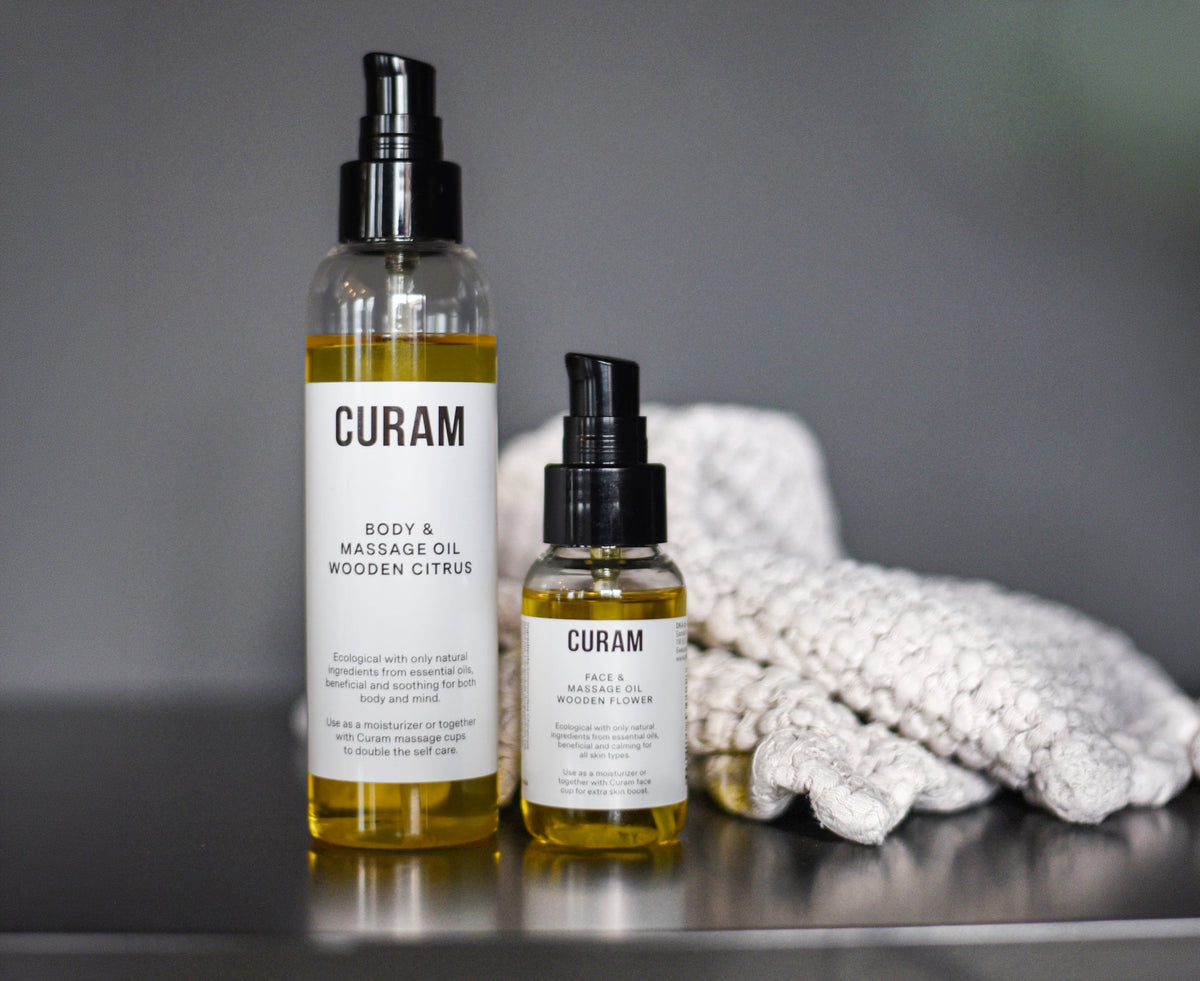
Curam Body & Massage Oil, Wooden Citrus
The body oil is an organic blend of rice bran and jojoba oil with essential oils of lemon eucalyptus, cedarwood and lavender. It is made so the cup glides without letting go, absorbs without feeling sticky, and works just as well as a body oil after the shower, in the shower and in the sauna. 150 ml pump bottle.
Curam Face & Massage Oil, Wooden Flower
The face oil has a base of organic jojoba with lavender, geranium, vetiver and frankincense. Jojoba resembles the skin's own sebum, is non-comedogenic and suits all skin types, including sensitive and mature skin. It gives the right glide under light vacuum and can be used as a day or night oil and as a beard oil. 50 ml.
Both are 100 % plant-based, vegan and not tested on animals. Full ingredient lists (INCI) are on the product pages. Both together: Curam Oil Kit.
Can I use another oil?
| Oil | Body | Face | Comment |
|---|---|---|---|
| Jojoba | Good | Very good | Non-comedogenic, stable, stays on just long enough. |
| Sweet almond | Very good | OK for normal skin | Classic massage oil. Avoid with nut allergy. |
| Rice bran | Very good | Good | Light, long glide time, mild scent. |
| Grapeseed | Good | Good | Thin and light, absorbs a little faster. |
| Squalane | OK | Very good | Expensive for the body, excellent on the face. |
| Olive oil | Works | Avoid | Heavy, smells, can clog pores. |
| Coconut oil | Works | Avoid | Comedogenic; solidifies at room temperature. |
| Baby oil (mineral oil) | Avoid | Avoid | Too slippery, sits as a film, no value for the skin. |
| Body lotion / cream | Avoid | Avoid | Absorbs too fast, the cup lets go. |
| Shower gel (in the shower) | Works | No | Practical for body cupping in the shower. |
How much oil you need
Body: one to two pumps (about 2–3 ml) per area, for example one thigh. Face: three to five drops for the whole face. The skin should feel slick but not drenched. If the cup lets go, add a little; if it glides without sealing, wipe some off. A 150 ml bottle usually lasts two to three months with cupping three times a week; 50 ml of face oil about as long.
Three tips that make a difference
- Warm the oil in your palms before applying. Warm oil spreads more evenly and feels better.
- Oil the whole area before placing the cup, not just the starting point.
- Wash the cups after every session with warm water and mild soap, so oil residue does not go rancid in the silicone.
The technique with oil and cup step by step: Cupping at home and Face cupping: how to do it.
Frequently asked questions
What is the best oil for cupping?
A light plant oil with a long glide time: jojoba, rice bran or sweet almond for the body, jojoba or squalane for the face. Curam's oils are formulated for cupping, but other oils of the same type work.
Can I use coconut oil for cupping?
On the body it works, but it solidifies at room temperature and is hard to dose. On the face avoid it, since it can clog pores.
Do I need oil for static cupping?
No, but a small amount helps the cup seal on hairy or uneven areas.
Can I use the face oil on the body?
Yes, but it gets expensive. The body oil is made for larger areas. Body oil on the face works for most, but the face oil is adapted to the more sensitive skin.
My bottle is not completely full, is that right?
Yes. The bottle holds more than the 50 or 150 ml it contains, because natural oils can expand with temperature changes.
Written by Curam. Last updated 16 October 2026. This is general self-care information and does not replace medical care. For sudden, severe or unusual symptoms, contact your doctor. Talk to your doctor before cupping if you are pregnant, take blood thinners or have a condition affecting skin, blood vessels or blood.


