


Headaches have many causes, but by far the most common is tension headache. It feels like pressure or a band around the head, often comes in the afternoon and is almost always linked to tight muscles in the jaw, neck and shoulders. It is relieved by heat, movement, relaxing the jaw and massaging the tight muscles, and prevented best by regular breaks, sleep and water. Cupping is a simple way to reach exactly those muscles yourself. Here is how to recognise tension headache, what you can do at home, how to cup step by step and which signs mean you should see a doctor instead.
What is tension headache?
Tension headache is the most common type of headache: a pressure, heaviness or band around the forehead, temples or back of the head, on both sides, without nausea and not worsened by ordinary movement. The pain is mild to moderate and can last from half an hour to several days. Common triggers are stress, long concentration at a screen, poor sleep, dehydration, teeth grinding and static load on neck and shoulders. The muscles usually involved are the chewing muscles (masseter and temporalis), the deep neck muscles and the trapezius up to the base of the skull.
Migraine is different: often one-sided, pulsating, with nausea and sensitivity to light or sound, and worsened by movement. This guide is about tension headache; if you have migraine, discuss treatment with your doctor and use cupping only between attacks to release neck tension.
Which headache do you have? Tension headache, migraine or something else
Almost all headaches are harmless, but the types are treated differently. Here is how to tell the most common ones apart:
| Type | How it feels | What helps |
|---|---|---|
| Tension headache (most common) | Pressure or a band around the head, both sides, mild to moderate, often afternoon/evening, tight jaw, neck and shoulders | Heat, movement, breaks, relaxing the jaw, massage or cupping of the neck and shoulders – the rest of this guide |
| Migraine | Often one-sided, throbbing, moderate to severe, nausea, sensitivity to light and sound, worse with movement, sometimes an aura (visual disturbance) first | A dark, quiet room, medication early in the attack, preventive treatment via your doctor. Cupping only between attacks |
| Medication-overuse headache | Daily or near-daily headache in someone taking painkillers more than 10–15 days a month | Taper painkillers with support from your doctor |
| Cervicogenic headache (from the neck) | Starts in the neck and radiates forward to the forehead or eye, usually one-sided, triggered by neck movements or positions | Mobility and strength for the neck, physiotherapy, heat and cupping of the neck and shoulders |
| Cluster headache | Very intense, boring pain behind one eye, 15–180 minutes, watering eye/runny nose on the same side, in periods | Needs medical assessment and specific treatment |
| Sinuses, eyes, teeth | Aching in the forehead or cheeks with a cold, tired eyes after screens, pain from the jaw joint or teeth | Treat the cause: the cold, your eyesight, the teeth grinding |
If you are unsure which type you have, or have headaches on more than 15 days a month, let your doctor assess it. A sudden, very severe headache ("the worst of my life"), headache with fever and a stiff neck, or headache with numbness, difficulty speaking or confusion are emergency signs, see the next section.
When to seek care immediately
Call emergency services or go to A&E if the headache is sudden and the worst you have ever had, if it comes with a stiff neck and fever, confusion, speech difficulty, weakness or numbness on one side, loss of vision, or follows a blow to the head. See your doctor if the headache is new and recurs often, wakes you at night, worsens over weeks, or if you need painkillers more than two to three days a week (that in itself can cause headache). Cupping is not an option in those situations.
Self-care that helps
- The jaw. Notice whether you clench when you concentrate. Teeth apart, tongue on the palate, lips lightly closed. Massage the chewing muscles in front of the ears with your fingertips.
- Heat on neck and shoulders: a warm shower or a heat pack for 15 minutes.
- Movement and breaks. Stand up every half hour, roll the shoulders, look into the distance.
- Water and food. Dehydration and long gaps between meals are common triggers.
- Sleep at regular times, with a pillow that keeps the neck straight.
- Screen ergonomics: top of the screen at eye level, elbows supported.
- Relaxation: slow exhalation, progressive muscle relaxation or a guided ritual in the evening.
Cupping for tension headache, step by step
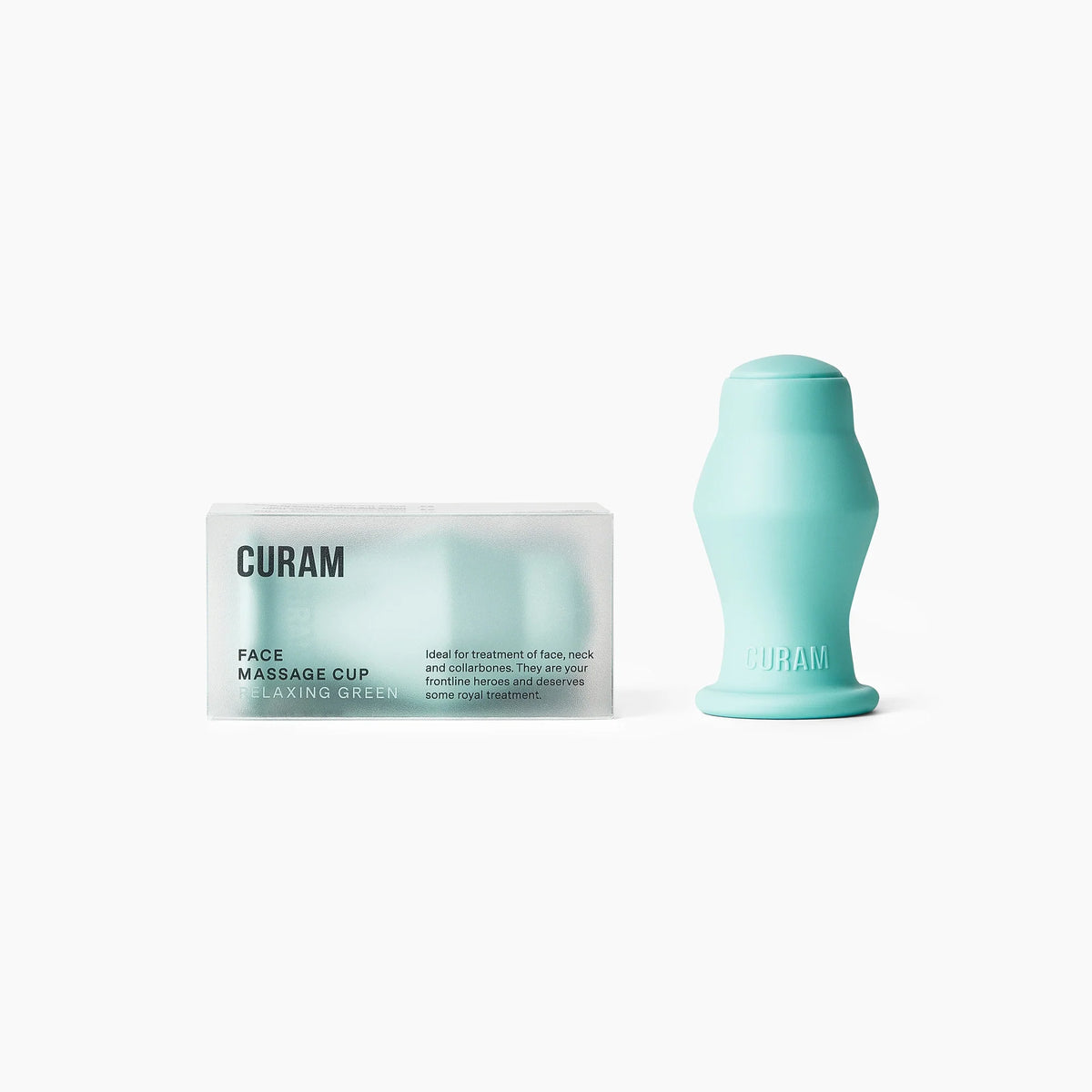
Cupping lifts the skin and connective tissue over the tight muscles, increases blood flow and often gives immediate relief in jaw and neck. You need Curam Face Cup with face oil, and ideally two static cups for the shoulders. Do it in front of a mirror the first few times.
- Shoulders first. Place a static cup on top of each shoulder, on the trapezius, and leave them for three to five minutes while you do the rest.
- Neck. Oil the neck. Place a static cup on each side of the neck just below the base of the skull (never on the spine itself or the front of the neck), for up to ten minutes. Or glide the dynamic mini cup in slow strokes from the skull base down towards the shoulders.
- Open the lymphatic flow. Pump lightly with the face cup at the collarbones and in front of the ears, three to five times per spot.
- Jaw. Oil. Place the face cup on the jaw muscle and pump three to five times. Then glide the cup slowly from the chin along the jawline out under the ear. Repeat three to five times.
- Temples and forehead. Pump along the forehead out to the temple. Glide the cup from between the brows up to the hairline, and from the brows horizontally out to the temples. Three to five strokes per lane. Keep the cup moving.
- Finish downwards. Glide from the temples down in front of the ears, along the neck to the collarbones, so the fluid has somewhere to go. Do the other side. Remove the shoulder cups.
The whole routine takes ten minutes. For acute pain: do it straight away. Preventively: two to three times a week, ideally in the evening. Programme with pictures: Cupping programme for tension headache and tight jaw. How face cupping works in general: Face cupping: how to do it.
Prevent: a weekly routine
- Daily: jaw check at the screen, a short walk, water.
- Three times a week: ten minutes of cupping for shoulders, neck and jaw.
- As needed: static cups on the shoulders while you work, read or watch TV, three to five minutes.
- Stiff neck too? Read Stiff neck and tight shoulders.
When not to cup
Do not cup with fever or infection, on damaged or inflamed skin, directly on the front of the neck or on the spine, on blood thinners without your doctor's advice, and not on the face within two weeks of Botox or four weeks of fillers. If you feel dizzy or nauseous, stop and rest lying down.
Frequently asked questions
Does cupping help with tension headache?
Many people get relief when the tight muscles in jaw, neck and shoulders are treated, and that is where tension headache originates. Evidence for cupping specifically for headache is limited, so treat it as a complement to movement, sleep and stress management.
Where do I place the cups for headache?
Static cups on the shoulders and on each side of the neck below the skull base. The face cup on the jaw muscle, temples and forehead, always moving. Never on the spine or the front of the neck.
Can I cup during a migraine attack?
No, rest in the dark and follow the treatment you have been given. Use cupping between attacks to release neck tension, if you find it helps.
How often?
For acute pain whenever needed. Preventively two to three times a week.
Why do I get a headache from cupping?
Usually dehydration, or too much suction on the neck. Drink water before and after and use lighter suction. If it keeps happening, avoid the neck and talk to your doctor.
Written by Curam. Last updated 17 October 2026. This is general self-care information and does not replace medical care. For sudden, severe or unusual symptoms, contact your doctor. Talk to your doctor before cupping if you are pregnant, take blood thinners or have a condition affecting skin, blood vessels or blood.


