


Facial massage at home gives the most when you do it regularly, with light pressure, always outwards and upwards, finishing towards the collarbones so the lymph fluid has somewhere to go. You need no tools to start, but a face cup or a gua sha makes the routine faster and more effective. Here is why facial massage works, five hand techniques, lymphatic massage for the face, how the tools differ, and a routine for five and ten minutes.
Why facial massage?
The face has more than forty muscles that we tense all day without noticing. The skin on top moves less and gets poorer circulation. Facial massage increases blood flow (a fresh glow straight after), supports lymphatic flow (less morning puffiness around eyes and jaw) and releases tension in jaw, temples and forehead so that, over time, the expression softens and tension lines show less. What it does not do is remove wrinkles or replace skincare. Think of it as training for the face.
The basics, whatever the technique
- Cleanse your face and wash your hands.
- Use an oil or balm so fingers and tools glide. Never drag dry skin.
- Light pressure. Lymph vessels are superficial and respond to light touch, not force.
- Direction: from the centre of the face outwards, and from the bottom up. Always finish with strokes down the neck towards the collarbones.
- Five minutes three to four times a week beats twenty minutes once a month.
Facial massage with the hands: five techniques
1. Open the lymph nodes
Fingertips in the hollows above the collarbones, press lightly and rhythmically ten times, like pumping. Then the same in front of the ears and under the jaw angles. This is what makes the rest of the massage effective.
2. Jaw
Knuckles under the cheekbones, glide slowly along the jawline towards the ears. Five times. Where the jaw muscles attach and feel hard, hold with light pressure for ten seconds while you breathe out.
3. Cheeks
With the fingertips, stroke from the nostrils out towards the ears in three lanes: under the cheekbone, over the cheekbone and along the lower edge of the eye. Five strokes per lane.
4. Eyes
With the ring finger, the weakest, make light circles around the eyes: from the inner corner out under the eye, up over the brow and back. Never press the eyelid itself.
5. Forehead
Glide with flat fingers from the centre of the forehead out to the temples, and from the brows up to the hairline. Finish with circles on the temples, then down in front of the ears, along the neck, to the collarbones.
Lymphatic massage for the face
Lymphatic massage is facial massage with even lighter pressure and a clear direction. The goal is not to soften muscles but to move fluid. Order is decisive: open the collarbones, neck and the area in front of the ears first, then work the face but always draw back outwards towards the ears and down towards the collarbones. Three to five light strokes per area. It suits mornings against puffiness especially well, and gives the biggest difference for puffy eyes. The full-body version: Lymphatic massage at home with cupping.
Gua sha, roller or face cup?
| Hands | Gua sha | Jade roller | Face cup | |
|---|---|---|---|---|
| What it does | Press and stroke | Scrapes/strokes with an edge | Rolls, light pressure | Lifts the skin with vacuum |
| Best for | Getting started, travel | Jawline, contours | Cooling, de-puffing | Lymphatic flow, tense jaw, glow |
| Learning curve | Low | Medium (angle and pressure) | Low | Low (keep it moving) |
| Time for the whole face | 10 min | 8–10 min | 5 min | 5 min |
| Risk if done wrong | Small | Redness if too hard | Small | Marks if the cup stands still |
The big difference is the direction of the force. Hands, gua sha and roller press down into the tissue; the cup lifts it up. The lift is what lets cupping reach jaw tension that is hard to get at with pressure, and stimulate lymphatic flow without any pressing at all. Detailed comparison: Gua sha or face cupping.
Facial massage with a face cup
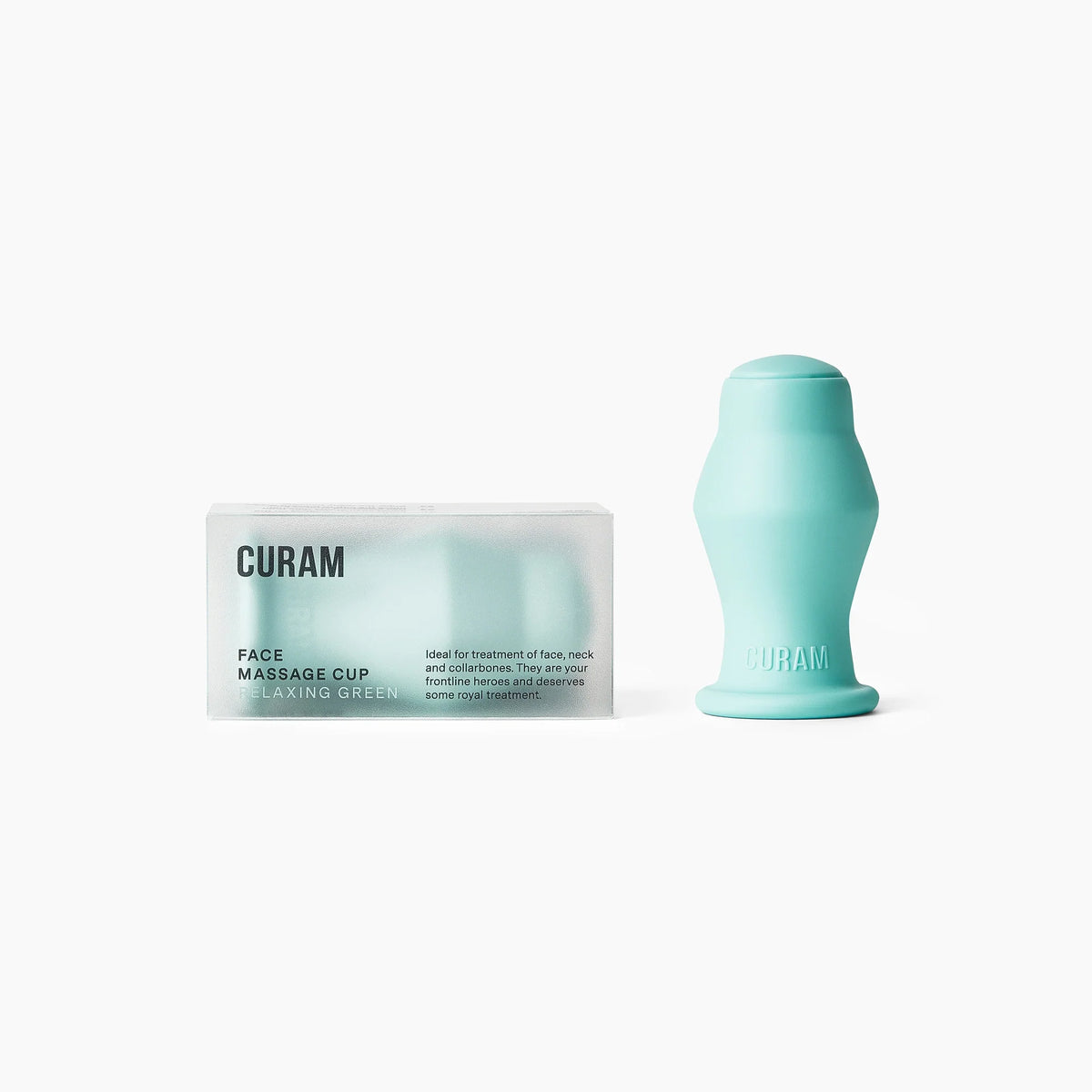
A face cup in silicone is squeezed lightly, placed on oiled skin and glided in slow strokes, always moving. Same order as with the hands: collarbones, neck, jaw, cheeks, eyes (with the mini cup), forehead, and back down to the collarbones. The whole face takes five minutes. Step by step: Face cupping: how to do it; what to expect over time: Facial cupping before and after.
Face yoga: five exercises that complement the massage
Face yoga is active exercise for the facial muscles, as opposed to massage, which is passive. The idea is to strengthen the muscles that lift (cheeks, mouth corners, eyelids) and teach the muscles that pull together and down (forehead, brows, jaw, mouth corners) to relax. The studies are small but point to somewhat fuller cheeks and a fresher expression after 20 weeks of daily practice, and many notice a clear difference in tension within a week or so. Five exercises, 30 seconds to a minute each, ideally after the massage when the muscles are warm: 1. The cheek lift: smile broadly with a closed mouth, place the fingertips lightly on the cheeks and "push" the smile up toward the eyes without squinting, hold 10 seconds, relax, 10 times. 2. Eye press: place the index fingers under the brows and lift lightly, try to close the eyes against the resistance with the lower lid, 10 slow repetitions; trains the muscle that counteracts bags. 3. Forehead: palms against the forehead with light pressure, try to raise the brows against the hand without the forehead creasing, hold 5 seconds, 10 times; teaches the forehead to relax. 4. Jawline and neck: head slightly back, push the lower jaw forward and "kiss the ceiling" with tense lips, hold 10 seconds, 5 times; firms the neck and jawline (double chin). 5. Tongue on the palate: press the whole tongue against the palate with the teeth apart, hold 10 seconds, 10 times; counteracts a tense jaw and supports the floor of the mouth. Avoid exercises that make the forehead crease or the eyes squint; they train the wrinkles in instead. The combination of massage or cupping (releases and drains) followed by face yoga (activates the lifting muscles) is what gives the most.
A 5- and a 10-minute routine
5 minutes (every evening or morning)
- Oil, open the nodes at the collarbones (30 sec).
- Jaw and cheeks outwards towards the ears (2 min).
- Eyes and forehead with light pressure (1.5 min).
- Finishing strokes down the neck (1 min).
10 minutes (2–3 times a week)
Same order with double the strokes per area, extra time on the jaw muscles and temples, and a final minute with the palms resting over the eyes while you breathe slowly.
How often, and when to skip it
With the hands you can massage daily. With gua sha or a face cup three to four times a week is enough, with rest days. Skip facial massage on active acne, eczema, rosacea flare-ups, sunburnt skin and open wounds. Wait about two weeks after Botox and about four after fillers, and ask your practitioner.
Common mistakes
- Too much pressure. The lymph is superficial. If the skin turns angry red you are pressing too hard.
- Wrong direction. Downwards and inwards works against the purpose.
- Skipping the collarbones. Then the fluid has nowhere to go.
- Dry skin. Without oil you drag the skin instead of gliding.
- Irregularity. Results are cumulative.
Frequently asked questions
Does facial massage help with wrinkles?
It can make tension lines in the forehead and jaw show less as the muscles relax, and gives more glow. It does not remove wrinkles caused by sun damage or lost elasticity.
Which oil should I use?
A light, non-comedogenic oil that gives glide without clogging pores, such as jojoba. Curam Face & Massage Oil is made for facial massage and face cupping.
Can I do facial massage every day?
Yes, with the hands and light pressure. With tools, three to four times a week is enough.
Is face yoga the same as facial massage?
No. Face yoga trains the muscles through active exercises; facial massage relaxes them and stimulates circulation and lymphatic flow. They complement each other.
Why am I puffy after facial massage?
Usually because the pressure was too hard or you did not open the lymph nodes at the collarbones first. Redo the routine lighter, with a clear direction outwards and downwards.
Related guides
- Forehead wrinkles, nasolabial folds and eye wrinkles – what helps
- Massage – types, effects and how to massage at home
- Skincare routine morning and evening – with face cupping
- Head massage and scalp massage – how to do it
Written by Curam. Last updated 16 October 2026. This is general self-care information and does not replace medical care. For sudden, severe or unusual symptoms, contact your doctor. Talk to your doctor before cupping if you are pregnant, take blood thinners or have a condition affecting skin, blood vessels or blood.


