


Runner's knee is an umbrella term for overload problems around the knee from running: either on the outside of the knee (iliotibial band syndrome) or around and behind the kneecap (patellofemoral pain and jumper's knee). It is almost always caused by increasing training too fast combined with weak hip and glute muscles, and it is relieved by temporarily reducing load, strengthening the hips and working on the muscles around the knee, not by weeks of rest. Cupping is a good way to soften the outer thigh, the calf and the muscles around the knee, but never the knee joint itself. Here is how to recognise it, what to do, how to cup and when to see a doctor.
Recognise the problem
- Runner's knee (iliotibial band syndrome): sharp or burning pain on the outside of the knee that appears after a certain number of minutes of running, often worse downhill, and disappears at rest.
- Patellofemoral pain: dull ache around or behind the kneecap, worse on stairs, squatting and after sitting long with bent knees.
- Jumper's knee: pain in the tendon just below the kneecap, worse with jumping, sprinting and at the start of a session.
Common to all: the pain is linked to load, the knee is not swollen, does not lock and does not give way.
Jumper's knee: when it hurts below the kneecap
Runner's knee hurts on the outside of the knee (ITB) or around and behind the kneecap (anterior knee pain); jumper's knee (patellar tendinopathy) hurts at a distinct point just below the tip of the kneecap, where the patellar tendon attaches, and is tender when you press there. It comes from repeated jumps, landings and sharp stops (volleyball, basketball, football, padel, but also hill running and deep squats), hurts at the start of the session, eases as you warm up and returns afterwards and the next day, and at worst also on stairs and after sitting long. Rest doesn't heal the tendon; what has the best evidence is heavy, slow strength training of the front thigh (squats or leg press three seconds down, three seconds up, three times a week for twelve weeks) and in the more acute stage isometric loading (hold a half squat or a leg extension for 45 seconds, five times), which dampens the pain for several hours. Reduce jumping and hill running temporarily but don't stop loading. Cupping is used on the front thigh and hip flexor, which are often short and tight and pull on the tendon, not on the tendon attachment itself, which gets worse from suction in the acute stage; see the steps below and Achilles tendinopathy for the same principle on the Achilles.
When to see a doctor
Seek care if the knee swells, locks, gives way, is warm and red, if the pain followed a twist or a fall, if you cannot bear weight on the leg, or if the problem has not improved in four to six weeks despite reduced load. Children and teenagers with knee pain should always be assessed. Do not cup a swollen or injured knee.
Runner's knee exercises and what helps
- Reduce, do not stop. Cut running volume to the level where pain stays below three on a ten-point scale and is gone the next morning. Temporarily swap downhills for flat ground, and shorten your stride slightly.
- Strengthen hips and glutes three times a week: side-lying leg raises, clamshells, single-leg squats, hip thrusts, lunges. A weak hip is the most common reason the knee is loaded unevenly.
- Build the tendon for jumper's and patellofemoral pain: slow squats on a decline board or Spanish squats, heavy and slow, three times a week.
- Soften the outer thigh, quads and calf: cupping (below), foam roller, light stretching after the session.
- Build back slowly: no more than ten percent more per week, alternating with cycling or swimming.
- Shoes and surface: replace worn shoes, vary the surface.
Cupping around the knee, step by step
The target is the muscles and connective tissue that pull on the knee: outer and front thigh, hamstrings, calf and the area around the kneecap. Never directly on the kneecap, in the back of the knee or on a swollen knee. You need the Dynamic Cup, the mini cup, static cups and body oil.
- Oil the whole thigh, the area around the knee and the calf. Do it after training or a warm shower.
- Outer thigh. Glide the Dynamic Cup slowly from just above the knee up towards the hip along the outside of the thigh. Five to eight strokes. It is often very tight here; use light suction the first times.
- Front and back of the thigh. Long strokes from the knee up towards the groin and the glutes respectively. Five strokes per surface.
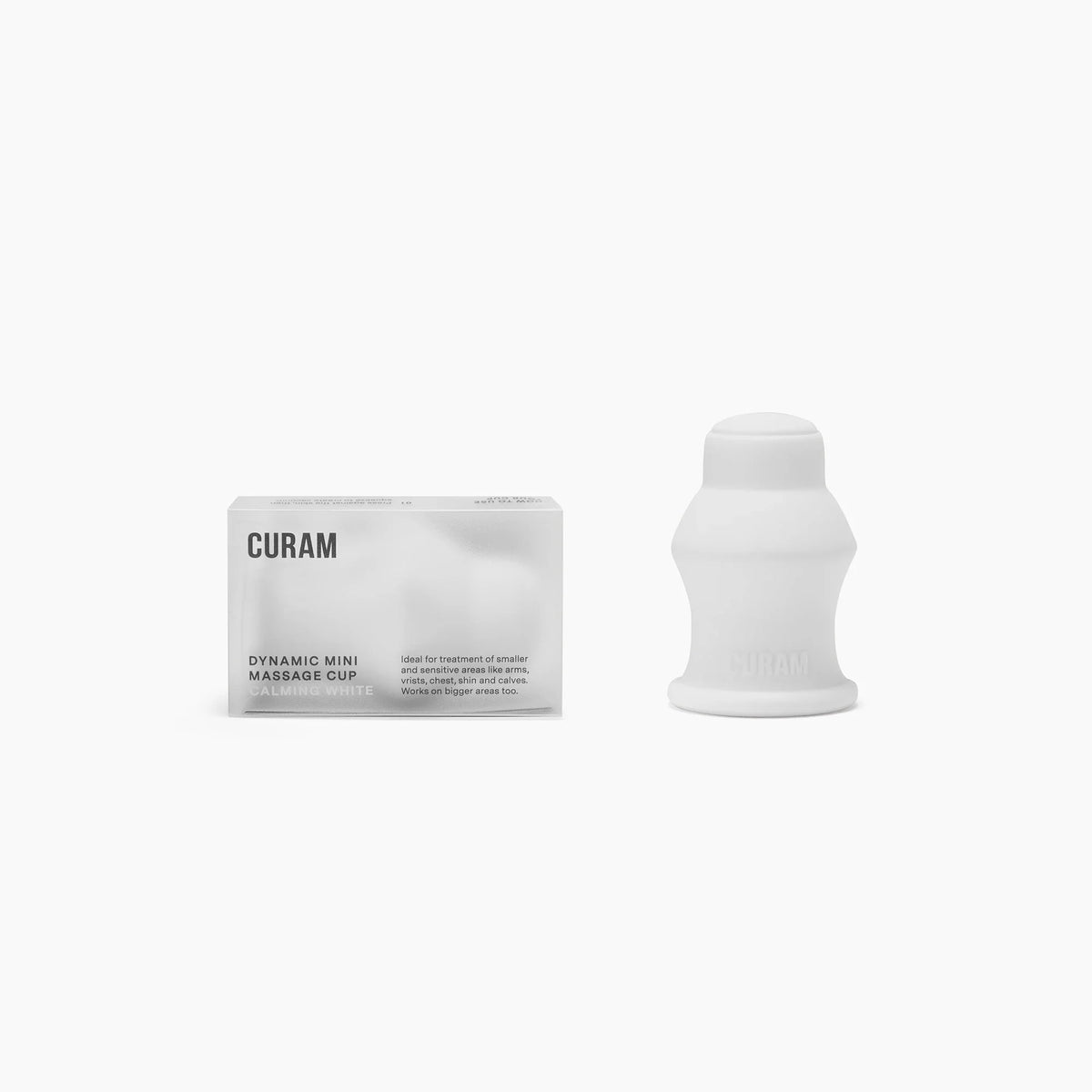
- Around the knee. Switch to the mini cup. Move it in small up-and-down motions on the inside and outside of the knee, above and below the kneecap, without crossing the kneecap itself or entering the back of the knee. Two to three minutes.
- Calf. Strokes from the heel up towards the back of the knee on the inside, back and outside of the calf, three to five per lane, letting the cup release before the knee fold.
- Static on tight spots. Place static cups on either side of the knee, above and below, or on the outer thigh where it is most tender, for one to three minutes.
Before running: a shorter version, three minutes per leg, as a warm-up. After: the full routine with light suction. Programmes with pictures: Cupping programme for sensitive knees and Cupping programme for runners.
After knee surgery
Cupping around the knee can support circulation once the wound has healed and the stitches are out, but wait at least six to eight weeks before cupping the scar itself, start with the face cup for very light suction, and follow your physiotherapist's plan. Always ask your doctor first.
When not to cup the knee
With swelling, warmth or redness, after an acute injury, with suspected meniscus or ligament injury, on varicose veins, with a blood clot or on blood thinners without a doctor's advice, and never directly on the kneecap or in the back of the knee.
Frequently asked questions
Can I cup my knees?
Around the knee, yes: on the muscles and connective tissue above, below and on the sides. Not on the kneecap, in the back of the knee or on a swollen knee.
Should I stop running with runner's knee?
Usually not completely. Reduce volume to a level where pain is low and gone the next day, switch to flat ground, and build back up once hip strength has improved. With swelling or pain that does not decrease, see a doctor.
How long does runner's knee take to resolve?
Expect four to twelve weeks with adjusted load and strength training. The earlier you adjust, the shorter.
Foam roller or cupping, which is better?
Both soften the outer thigh. The cup lifts the tissue instead of pressing, which many find gentler on tender areas, and it reaches around the knee where the roller cannot.
Which cup suits knees?
The Dynamic Mini Cup around the knee, the large Dynamic Cup on the thigh, and static cups on tender points.
Related guides
- Knee osteoarthritis and knee pain – exercise, self-care and what cupping can add
- Shin splints – train your way back and cup the calves
- Achilles tendinopathy – the exercises that heal and cupping the calf
- Hip pain – what the location tells you, self-care and cupping
- Balance exercises at home – 8 exercises in three levels
- Swollen knee and fluid on the knee – causes and what helps
- Warm-up before training – exercises that work
- Leg and glute exercises at home – 12 exercises
- Muscle strain in the calf and thigh – rehab week by week
- Meniscus tear – symptoms, locking, exercises and cupping
- Knee pain – where does it hurt and what can it be?
- Growing pains, Osgood-Schlatter and Sever's – leg pain in children
- Kinesiology tape – how to tape knee, shoulder and back, and tape or cupping
- Cracking knees and popping joints – harmless or not, and what helps
- Thigh pain – front, back, outside and inside: what it can be
- Calf pain – where does it hurt and what it can be
- Sprained ankle – what to do right away and rehab
Written by Curam. Last updated 16 October 2026. This is general self-care information and does not replace medical care. For sudden, severe or unusual symptoms, contact your doctor. Talk to your doctor before cupping if you are pregnant, take blood thinners or have a condition affecting skin, blood vessels or blood.


