


Knee osteoarthritis is the most common cause of knee pain in adults over 45. The joint cartilage becomes thinner and rougher, the joint capsule is irritated and the muscles around the knee weaken, giving aching on loading, morning stiffness that passes within half an hour, swelling after exertion and difficulty with stairs. Osteoarthritis does not mean the joint is "worn out" or that you should rest: the best documented treatment for osteoarthritis pain is adapted exercise two to three times a week, followed by weight control and knowledge about the condition, which is exactly what Swedish osteoarthritis education programmes are built on. The X-ray and the pain also do not always match; many people with clear changes have little pain, and vice versa. Cupping cannot affect the cartilage, but it can relieve tension and aching in the muscles around the knee; the research on cupping for knee osteoarthritis is mixed, and we report it honestly below. Here is how to recognise knee osteoarthritis, other common causes of knee pain, what helps, when to see a doctor and how to cup around the knee.
What is knee osteoarthritis, and what other causes of knee pain are there?
Osteoarthritis is a disease of the whole joint, not just the cartilage: cartilage is broken down faster than it is built up, the bone underneath thickens, bony outgrowths form and the joint lining can be inflamed in periods. Risk factors are age, heredity, overweight, previous knee injuries (cruciate ligament, meniscus), heavy knee-loading work and weak thigh muscles. Typical of knee osteoarthritis: pain on loading and when getting up, morning stiffness under 30 minutes, crunching sounds, swelling after activity, difficulty squatting and going down stairs. The diagnosis is made on symptoms and examination; an X-ray is rarely needed to start treatment.
Other common causes of knee pain: runner's knee (pain on the outside of the knee or around the kneecap in active people), jumper's knee (the patellar tendon), bursitis (swelling at the front), meniscus injury (locking, pain on twisting), and pain radiating from the hip or lower back. In children and teenagers, knee pain should always be assessed.
Pain behind the knee
Pain or tightness at the back of the knee has a few typical causes. A Baker's cyst is a fluid-filled bulge in the back of the knee that is often linked to osteoarthritis or a meniscus injury and feels like a tight lump, worse when the knee is fully straightened; it is treated by treating the cause. Overworked muscle attachments (hamstrings and the upper part of the calf muscle) give tenderness behind the knee after running, hills or jumping and respond to rest, stretching and a gradual return. The back of the meniscus gives pain behind the knee with deep bending and twisting. Sudden pain and swelling behind the knee and in the calf together with warmth may be a blood clot and should be assessed urgently. Never cup in the back of the knee itself; work on the back of the thigh and the calf as in the routine below.
When to see a doctor
Seek urgent care if the knee is warm, red and markedly swollen with a fever (joint infection), if the knee swelled quickly after an injury or cannot bear weight, if the knee locks completely, if you have swelling and aching in the calf at the same time (blood clot), or if the pain is very severe and came suddenly. Contact your doctor if you have recurrent swelling, a knee that gives way, night pain at rest, unexplained weight loss, if you are under 20 or have another joint disease, or if you have had pain for more than four to six weeks. With suspected osteoarthritis the right route is your practice's physiotherapist and an osteoarthritis education programme, not an X-ray referral first.
What really helps
- Exercise as medicine, two to three times a week. Strength for the front and back of the thigh, the hip and the calf (seated knee extensions, squats to a chair, short-step lunges, hip bridges, heel raises), mobility for the knee and aerobic training such as cycling, swimming or walking. Pain up to 5 on a ten-point scale during exercise is acceptable if it has settled by the next day. The effect comes after six to twelve weeks and lasts as long as you continue. An osteoarthritis education programme (through your practice or digitally) gives you a programme and follow-up.
- Weight control. Every kilo less reduces the load on the knee several times over when walking. Five percent weight loss gives measurably less pain for those who are overweight.
- Keep moving in daily life. Sitting still makes osteoarthritic knees stiffer; change position often, take the stairs when you can, get up every half hour.
- Pain relief when needed so that you can exercise: paracetamol or an over-the-counter anti-inflammatory gel on the knee as advised by your pharmacist. Anti-inflammatory tablets short-term and on medical advice if you are older or have heart, kidney or stomach problems.
- Heat and cold. Heat for stiff muscles and before exercise; cold for 15 minutes after activity when the knee is swollen.
- Shoes and aids. Cushioned shoes, possibly wedge insoles, a pole or stick on long walks if needed. A knee support gives some people confidence but builds no strength.
- Sleep and stress affect the pain experience considerably; prioritise them.
- Medical options when exercise and self-care are not enough: cortisone injection for clear inflammation (temporary relief), physiotherapy, and for severe osteoarthritis with major functional limitation a knee replacement, which gives very good results but is the last step, not the first.
What does the research say about cupping for knee osteoarthritis?
Honestly: the results are mixed. A German study (Teut et al. 2012) found that pulsatile dry cupping gave less pain and better function than no treatment after four weeks, and an evidence synthesis (Complementary Medicine Research 2018) judged that cupping may have an effect on pain in knee osteoarthritis but that the studies are small and of low quality. A more recent randomised trial (Brazilian Journal of Physical Therapy 2026), however, found no effect of dry cupping on pain, function or quality of life in women with knee osteoarthritis compared with placebo. Overall: cupping can give temporary relief of aching and tension in the muscles around the knee for some, but does not affect the disease and is no alternative to exercise. We use it as a way to get going with exercise when the knee is stiff and tender, not as a treatment for the osteoarthritis. More on the state of the research in Cupping in numbers.
Cupping around the knee, step by step
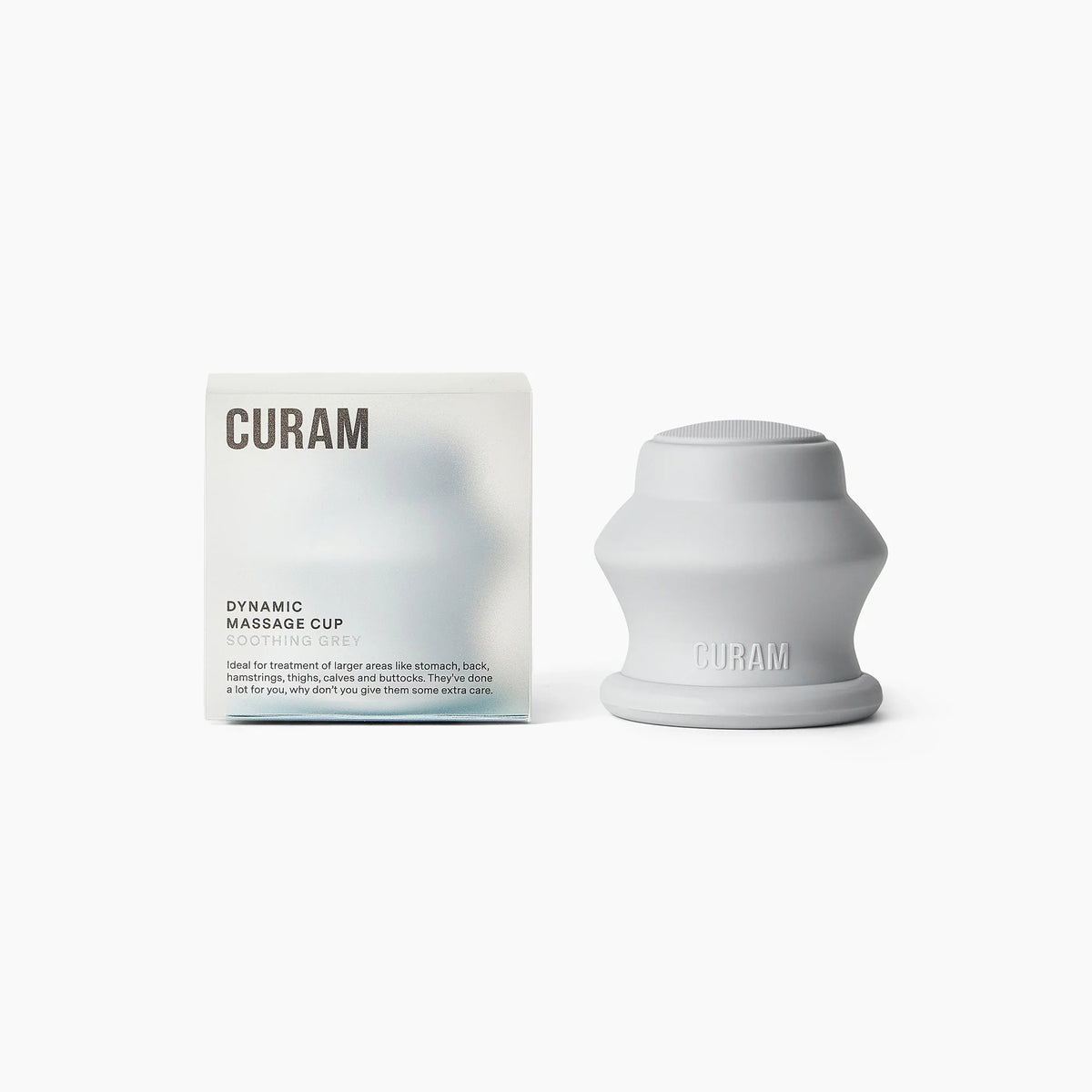
The target is the muscles that control the knee: the front of the thigh (quadriceps), which is often weak and tight, the back of the thigh, the outside of the thigh (iliotibial band) and the calf. The knee joint itself is not cupped. You need the dynamic cup for the thigh, the mini cup for the calf and around the kneecap, ideally static cups, and body oil. You can do all of it yourself sitting or lying down.
- Warm up the knee and thigh with a heat pad or shower for ten minutes, or do it after a light training session.
- Front of the thigh. Oil. Glide the cup with light suction in slow strokes from just above the kneecap up towards the hip, in three lines (inside, middle, outside), five to eight strokes per line.
- Outside of the thigh from the outside of the knee up towards the hip; this line is often tender and tight.
- Around the kneecap. With the mini cup and very light suction, small circles in the soft tissue above and either side of the kneecap. Not on the kneecap, not in the back of the knee.
- Back of the thigh and the calf. Lie on your stomach or sit with the leg on a stool. Strokes from the back of the knee up towards the buttock and from the heel up towards the back of the knee, light suction, release before the back of the knee.
- Static. One to two static cups with light suction on the most tender points of the front and outside of the thigh, two to three minutes. Not over a swollen knee.
- Finish with a few slow squats to a chair and a walk; cupping should lead into movement.
Two to three times a week, ideally before the training session. The basics of static and dynamic cupping are in Cupping at home. If the knee pain comes from running or sits around the kneecap in an active person: Runner's knee and sensitive knees.
When not to cup
Not on the knee joint itself or in the back of the knee, not on a warm, red or markedly swollen knee, not after an injury before it has been assessed, not over a knee replacement without asking your orthopaedic surgeon, not on varicose veins, wounds or bruises, not with a suspected blood clot in the calf, and not without medical advice if you take blood thinners, are pregnant or have rheumatic disease in a flare. If pain or swelling increases after cupping, stop.
Frequently asked questions
Is it dangerous to exercise with knee osteoarthritis?
No, on the contrary: exercise is the best documented treatment and does not wear out the joint. Pain up to 5 out of 10 during the session is acceptable if it has settled by the next day. Start with an osteoarthritis education programme or a physiotherapist if you are unsure.
Does cupping help with knee osteoarthritis?
Not the osteoarthritis itself. The studies are mixed: some show less pain compared with no treatment, the most recent placebo-controlled trial shows no effect. Cupping the thigh and calf muscles can relieve tension and aching temporarily and make it easier to get going with exercise, which is what helps.
Do I need an X-ray of the knee?
Usually not to start treatment. The diagnosis is made on symptoms and examination, and the treatment (exercise, weight, knowledge) is the same whatever the image shows. An X-ray becomes relevant if surgery is being considered or the picture is unclear.
Can I get rid of osteoarthritis?
Osteoarthritis does not reverse, but most people can get considerably less pain and better function with regular exercise and weight control, and many never need surgery. The pain is governed more by muscles, load, sleep and stress than by what the cartilage looks like.
When is it time for a knee replacement?
When, despite at least three to six months of structured exercise, weight control and pain relief, you have severe pain and major functional limitation in daily life. The decision is made together with an orthopaedic surgeon. Exercise before the operation also improves the result afterwards.
Sources
- 1177 Vårdguiden (Swedish national health guide), search for "artros" for medical information and when to seek care.
- Teut M et al. Pulsatile dry cupping in patients with osteoarthritis of the knee – a randomized controlled exploratory trial. BMC Complement Altern Med 2012. DOI
- Cupping Therapy for Knee Osteoarthritis: A Synthesis of Evidence. Complement Med Res 2018. DOI
- Dry cupping therapy has no effect on pain, function, or quality of life in women with knee osteoarthritis: randomized controlled trial. Braz J Phys Ther 2026. DOI
- Curam's FAQ and cupping programmes, developed together with trained massage therapists.
Written by Curam. Last updated 17 October 2026. This is general self-care information and does not replace medical care. For sudden, severe or unusual symptoms, contact your doctor. Talk to your doctor before cupping if you are pregnant, take blood thinners or have a condition affecting skin, blood vessels or blood.


