


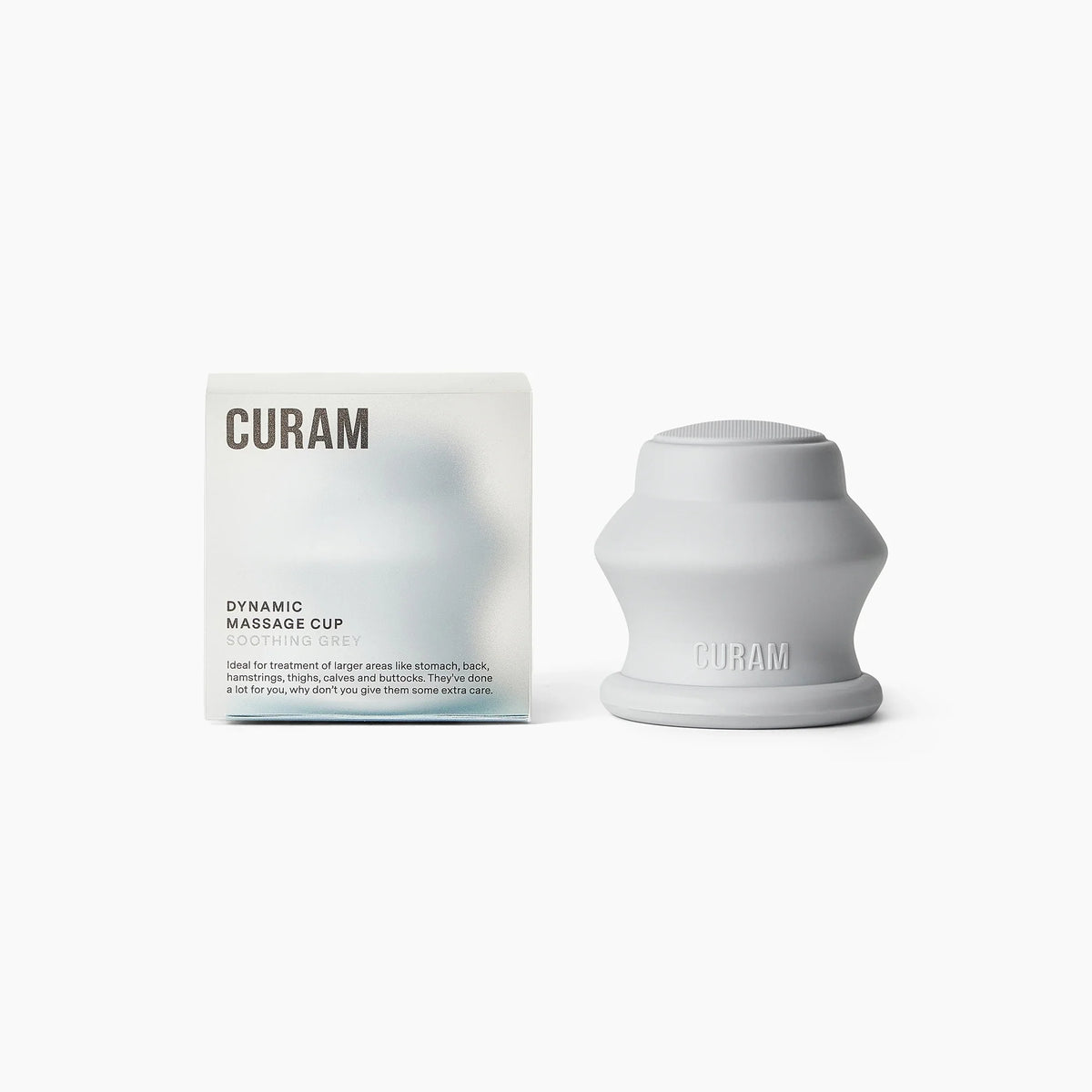
A massage ball and cupping are opposites in technique: the ball presses a small point deep into the muscle with your body weight, the cup lifts the skin, fascia and the surface layer of the muscle upwards with negative pressure. That is why they are good at different things. The ball wins on tender points that need pressure (trigger points in the glutes, sole, between the shoulder blades, chest muscle), where you can lie still on a point until it releases. The cup wins on larger areas and tight fascia (thighs, calves, back, neck), where you want circulation and pliability without pressing on tender structures, and on places where pressure hurts or is unsuitable (over bone, thin tissue, swelling). Most people benefit from both, in the right order: the cup first to warm and soften, the ball afterwards on the points that remain. Here is the difference in detail, what suits where, how to use the ball correctly and a combined routine.
The difference in brief
| Massage ball | Cupping (dynamic) | |
|---|---|---|
| Mechanism | Pressure inwards on a point, with body weight | Lift outwards of skin, fascia and muscle, with negative pressure and gliding |
| Best for | Trigger points, deep small muscles (piriformis, sole, chest muscle attachment, between the shoulder blades) | Large muscles and fascia (thighs, calves, back, neck), circulation, stiffness, soreness, lymph flow |
| Feel | Intense, "hurts in a good way", requires relaxing into the pressure | Warmth and pull, usually pleasant, skin turns pink |
| Not suitable | Over bone and joints, on nerves (back of the knee, armpit), with swelling, on thin tissue | On wounds, swollen joints, varicose veins, thin skin, fresh injuries |
| Time | 30–90 seconds per point | 1–3 minutes per muscle group |
| Leaves marks | Rarely | Sometimes pink or reddish rings that fade in days, see cupping marks |
| Research | Evidence for increased mobility and reduced pain in the short term for trigger points and plantar fasciitis | Evidence for reduced neck and lower back pain and increased mobility in the short term, see Cupping in numbers |
| Price and size | Cheap, fits in a pocket | Somewhat more expensive, needs oil |
Comparisons with other tools are in foam roller or cupping and cupping or massage gun.
Muscle knots: what they are and what releases them
The "knots" you feel in the neck, shoulders, glutes and calves are not knots in the muscle but trigger points: small areas where muscle fibres are in constant contraction, blood flow is low and the nerves are sensitive, so the point is tender to pressure and can give referred pain (a knot in the upper trapezius often gives a headache in the temple, one in the glutes an ache down the thigh). They arise from static load, one-sided movements, stress, cold and poor sleep. What releases them is pressure or lift until the point lets go (the ball or a still cup for 30–90 seconds), heat, then stretching and moving the muscle through its full range, and dealing with the cause: breaks, posture, strength and sleep. A knot that does not release in a few weeks, sits in a swollen or hot area, or grows, is not a muscle knot and should be assessed. More on tension pain in the guide to muscle aches.
What suits where
- Glutes and piriformis: ball. Sit on the ball, lean towards the tender point, rock gently, 60 seconds per point. Cupping of the glutes afterwards for circulation. See the guide to piriformis syndrome.
- Sole of the foot: ball (ideally a slightly hard one, like a golf ball or a coolable ball) standing, roll and stop on tender points, 2 minutes; mini cup on the arch when the skin tolerates it. See plantar fasciitis.
- Between the shoulder blades: ball against a wall or floor on the small muscles beside the spine (never on the vertebrae), 60 seconds per point; static cups if you have help. See upper back pain.
- Chest muscle and front of the shoulder: ball against a door frame, 60 seconds; dynamic cup below the collarbone for mobility. See posture.
- Neck: cup (mini cup on the upper trapezius and base of the skull); ball only against the skull-base muscles lying on your back with the ball under the base of the neck, carefully, never on the front of the throat.
- Thighs and calves: cup for the whole muscle; ball on single tender points in the calf sitting with the leg on the ball. See calf cramps.
- Lower back: cup on the muscles beside the spine, never a ball directly on the lower back (the pressure goes towards the vertebrae); a ball, however, on the glutes which are often the source. See Cupping on the back.
- Forearms and hands: mini cup on the forearm; a ball in the palm and against the forearm muscles on the table. See thumb pain.
- Swelling and lymph: cup only, with light suction; the ball's pressure pushes fluid the wrong way.
How to use the massage ball correctly
- Choose size and hardness: a tennis ball for beginners and sensitive areas, a lacrosse or rubber ball for glutes and thighs, a golf ball or small hard ball for the sole. Two balls in a sock ("peanut") for beside the spine.
- Place the ball against the wall, floor or chair, put the tender point on the ball and lean in until it feels clear but bearable, around 6–7 out of 10.
- Lie still and breathe calmly. The pressure should decrease in 30–90 seconds as the muscle releases; if it does not, move on instead of pressing harder.
- Move the joint the muscle controls while the ball stays in place (bend and straighten the knee with the ball under the hamstrings, roll the shoulder with the ball on the chest muscle); that enhances the effect.
- At most three to five points per area and day; more gives soreness instead of relief. Wait a day before the same point again.
- Never on bone, joints, the spine, the front of the throat, the back of the knee, the armpit or the groin, where nerves and vessels lie superficially. Not with swelling, varicose veins, freshly injured muscle or blood-thinning treatment without consulting.
Combine: a ten-minute routine
- Cup first, 1–2 minutes per area, with the dynamic cup and oil: thighs, calves, glutes or back depending on the day. That warms, increases circulation and softens the fascia so the points become fewer and less tender.
- Ball on what remains, 60 seconds per point: the deep points of the glutes, the sole, the chest muscle attachment or beside the spine.
- Finish with movement: a minute of mobility exercises for the area, or ten deep breaths with static cups on the chest if the aim is to wind down.
After training: cup for soreness, ball only if a specific point bothers you. Before training: quick light cupping as a warm-up, no ball (long pressure on a point relaxes the muscle), see the guide to warming up. The full recovery routine is in the Curam Recovery method.
Frequently asked questions
What is the difference between a massage ball and cupping?
The ball presses a point deep into the muscle with your body weight, the cup lifts skin, fascia and muscle with negative pressure and glides over the surface. The ball suits trigger points in small deep muscles, the cup large muscles, fascia, circulation and stiffness. They complement each other.
Which is best for trigger points?
The ball, since a trigger point responds to still pressure for 30–90 seconds. Cupping beforehand makes the points fewer and less tender, and static cups left over a point work for those who cannot tolerate pressure.
Can you use a massage ball on the back?
On the muscles beside the spine and between the shoulder blades, yes, ideally with two balls in a sock so the spine stays free; never directly on the vertebrae and not on the lower back, where the pressure goes towards the vertebrae and kidneys. The lower back is cupped instead, and the glutes, often the source, take the ball.
How long should you lie on a massage ball?
30–90 seconds per point, until the pressure decreases, at most three to five points per area and day. Longer or harder gives soreness instead of relief. Wait a day before the same point again.
Which massage ball should you choose?
A tennis ball for beginners and sensitive areas, a lacrosse or hard rubber ball for glutes and thighs, a golf ball for the sole, and two balls in a sock for the back. Harder is not better; choose the one you can relax into.
Sources
- 1177 Vårdguiden (Swedish national health guide), search for "muskelvärk" and "träningsvärk" for general information.
- Curam's FAQ and cupping programs, developed with trained massage therapists; research overview in Cupping in numbers.
Related guides
- Fascia – what it is, fascia training and cupping
- Massage – types, effects and how to massage at home
Written by Curam. Last updated 17 October 2026. This is general self-care information and does not replace medical care. For sudden, severe or unusual symptoms, contact your doctor. Talk to your doctor before cupping if you are pregnant, take blood thinners or have a condition affecting skin, blood vessels or blood.


