


A muscle knot is not a knot and not an inflammation, but a trigger point: an area a few millimetres across in a muscle where a group of muscle fibres is stuck in contraction without being able to relax. The accepted explanation is that an overloaded or long-tense muscle gets local energy shortage, so the small motor endplates leak transmitter and the fibres contract into a knot; the contraction chokes blood flow, the oxygen shortage hurts, the pain increases tension, and the circle is closed. To the fingers it feels like a taut band in the muscle with a tender pea or bean on it, and when you press it three things happen that distinguish a trigger point from ordinary soreness: the pain is recognisable ("that's the one"), it refers to another place (from the shoulder up into the neck and head, from the buttock down into the thigh), and the muscle sometimes twitches. Research is not fully agreed on the mechanism and the diagnosis relies on touch, but the phenomenon is real, very common and predictable: the same muscles, the same points, the same referral in most people. Knots form from what overloads or locks a muscle: long screen work with the head forward, carrying, repetitive movements, hard unaccustomed training, cold and draughts, stress with raised shoulders, poor sleep, and an old injury that made other muscles compensate. Here is where the most common ones sit, where they refer, how to find and release them, and what keeps them away.
The most common knots and where they refer
| Muscle | Where you find the knot | Where the pain refers | Common cause |
|---|---|---|---|
| Upper trapezius | In the middle of the shoulder, in the "handle" between neck and shoulder | Up the side of the neck to the back of the head, the temple and behind the eye (tension headache) | Screen work, raised shoulders, carrying, stress |
| Levator scapulae | Where the upper inner corner of the shoulder blade meets the neck | Side of the neck, "stiff neck", difficulty turning the head | Phone between ear and shoulder, sleeping in a poor position, stress |
| Small muscles at the skull base (suboccipitals) | In the hollow under the skull base on each side of the spine | Into the head, behind the eyes, the forehead | Forward head, screen, reading in bed |
| Sternocleidomastoid (the large oblique neck muscle) | Along the muscle belly from behind the ear down to the collarbone (pinch gently between the fingers, don't press inwards) | Forehead, eye, ear, jaw; dizziness and sound sensitivity | Forward head, coughing, whiplash |
| Jaw muscles (masseter, temporalis) | On the outside of the cheek over the angle of the jaw, on the temple | Teeth, jaw joint, ear, temple | Teeth grinding, clenching, stress |
| Rhomboids and middle trapezius | Between the shoulder blades, along the inner edge of the shoulder blade | Locally between the shoulder blades, a "burning" point | Shoulders falling forward, screen work, rowing |
| Infraspinatus (on the shoulder blade) | In the middle of the flat of the shoulder blade below the ridge | Front of the shoulder and down the arm, difficulty reaching behind the back | Shoulder overload, throwing, side sleeping |
| Chest muscle (pectoralis) | In the edge of the muscle towards the armpit and under the collarbone | Front of the shoulder, inside of the arm, the chest | Shoulders falling forward, bench press, push-ups |
| Forearm extensors | On the top of the forearm near the elbow | Outside of the elbow (tennis elbow), wrist, fingers | Mouse and keyboard, gripping, racket |
| Quadratus lumborum (deep lower back muscle) | Between the lowest rib and the iliac crest, beside the spine | Lower back, iliac crest, buttock, sometimes groin; difficulty turning in bed | Uneven load, carrying on one side, long sitting |
| Gluteus medius and minimus | Just below the iliac crest on the side of the buttock | Down the outside and back of the thigh, resembles sciatica | Long sitting, weak glutes, running |
| Piriformis | Deep in the middle of the buttock | Buttock, back of the thigh; irritates the sciatic nerve | Sitting, stairs, running |
| Calf muscles (gastrocnemius, soleus) | In the middle of the calf belly, down towards the Achilles | Heel, arch of the foot, back of the knee; night-time calf cramps | Running, high heels, sitting still, cold |
| Tibialis anterior (front of the shin) | On the muscle belly just outside the shin bone | Front of the ankle, big toe | Running on hard surfaces, hills |
How to find your knots
- Warm up the muscle for a minute with a hot shower or light movement.
- Stroke with a flat hand and light pressure along the muscle in the direction of the fibres until you feel a taut band, like a string in the muscle.
- Follow the band until you find a point that is extra hard and tender. Press lightly and hold: a trigger point is recognised by the pain feeling familiar and often referring to another place.
- Grade it: 3–5 out of 10 is right to work with; 8–10 is too tender, start lighter or around it.
- Note where they sit: most people have the same knots over and over, and they sit where the load is.
How to release a muscle knot
1. Sustained pressure
Press with a fingertip, knuckle, elbow, massage ball or tennis ball against a wall or the floor, straight onto the knot, with a pressure of 5–7 out of 10 that "hurts good" but lets you breathe calmly. Hold for 30–90 seconds until the pain eases noticeably, release, and repeat two to three times. Don't work more than two to three minutes per point and not more than a few points a day; too hard and too long gives bruises and more tension the next day. See massage ball or cupping.
2. Cupping: lift instead of press
Cupping does the opposite of pressure: the suction lifts skin, fascia and the superficial muscle fibres upwards, so the contracted band is stretched and blood flow into the knot increases sharply instead of being shut off. For many knots, especially deep and very tender ones that don't tolerate pressure, and those in thick muscles such as glutes, thighs and lower back, cupping works better than a ball. Two techniques:
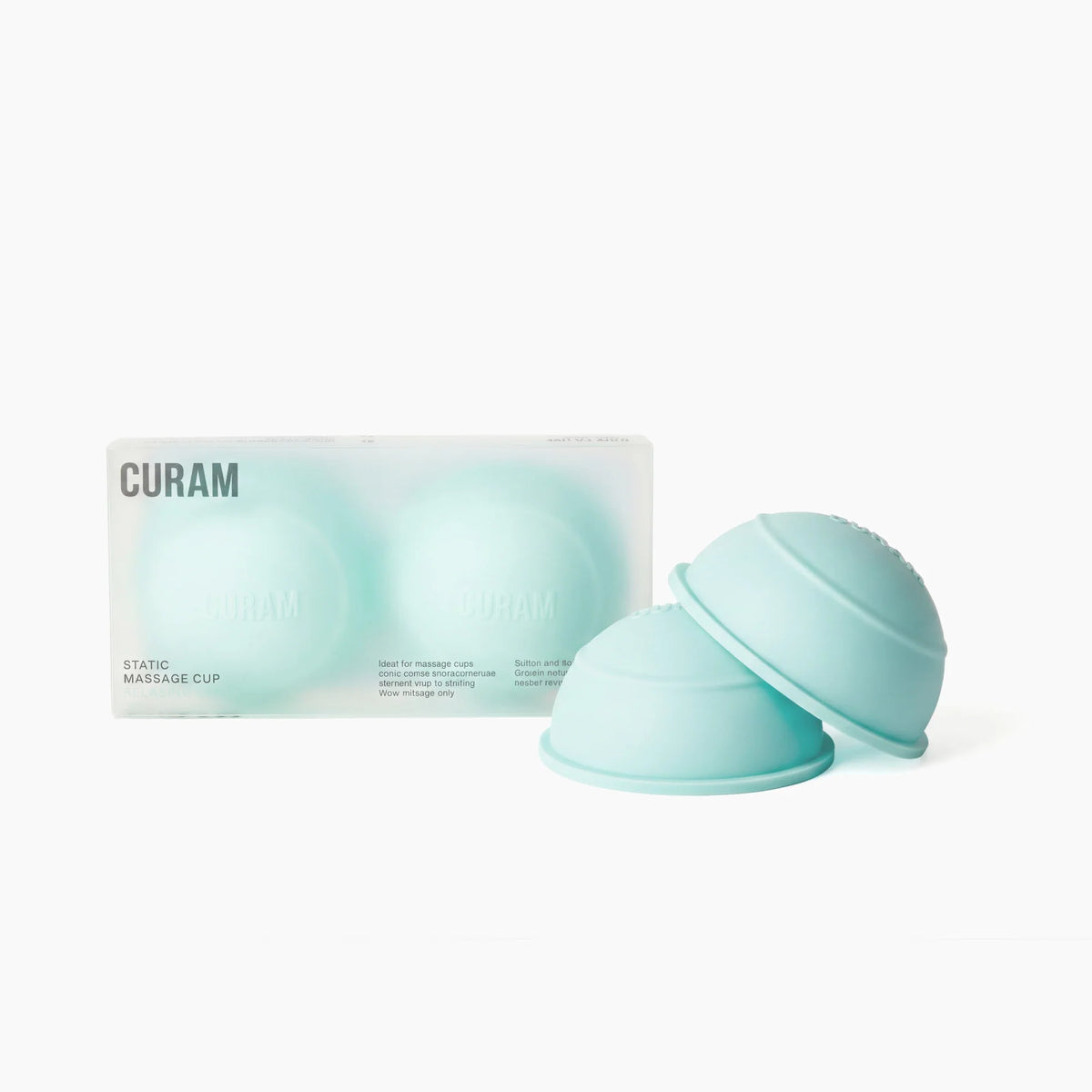
- Static cup on the knot: oil the skin, place a static cup straight over the trigger point with moderate suction (the skin should lift 1–2 cm, no more), leave it for 3–5 minutes while you breathe calmly and ideally move the body part slowly (turn the head with the cup on the trapezius, bend and straighten the knee with the cup on the calf). The movement under the cup is what releases the band. Expect a red-purple mark for a few days; it is blood pushed into the skin and harmless.
- Dynamic cupping along the band: glide the dynamic cup with light to moderate pressure along the taut band in the direction of the fibres, back and forth over the knot, 1–2 minutes; on small muscles (neck, forearm, skull base) the mini cup with minimal suction. Finish with a static cup on the most tender point.
Don't cup the front of the neck (the sternocleidomastoid and skull base are instead pinched gently with the fingers), not over varicose veins, wounds, acute inflammation or a fresh injury, not with fever, and not if you take blood thinners without having asked; see when to avoid cupping. Routines by area: cupping on the back, stiff neck and tight shoulders and the cupping programmes.
3. Heat before, stretch after
Heat for 10–15 minutes (shower, heat pad, sauna) makes the muscle softer and the knot easier to release. Right after pressure or cupping: stretch the muscle calmly for 30 seconds × 2–3, so the fibres that have just let go get their full length back. Without the stretch the knot often contracts again within a day.
4. Activate the muscle
After the stretch: 10–15 light repetitions of the muscle's movement (shoulder rolls for the trapezius, chin tucks for the skull base, hip lifts for the glutes, calf raises for the calf). That teaches the muscle to work through its full length again and is what gives lasting effect.
5. Professional help
Knots that don't release on their own are treated by a physiotherapist, chiropractor or massage therapist with pressure, dry needling (a needle in the trigger point, well documented) or cupping. Expect a few sessions to be needed and the homework between them to be decisive.
What keeps the knots away
- Break the static: breaks every 30 minutes with shoulder rolls, chin tucks and arm stretches; change working position; phone in the hand, not between ear and shoulder. See cupping for people who sit a lot.
- Strength where the knots sit: weak muscles get knots fastest. Rows and face pulls for shoulders and between the shoulder blades, neck flexion, side-lying leg raises for gluteus medius, calf raises for the calf; two sessions a week.
- Effortless posture: head over the shoulders, shoulders down; see forward head posture and better posture.
- Sleep and stress: sleep deprivation and stress lower the pain threshold and raise muscle tone; knots are often a barometer of the week. See stress.
- Warmth and fluids: cold and draughts on the neck give knots overnight; drink enough, and keep neck and lower back warm.
- Regular self-care: five minutes of cupping or ball on your usual points twice a week prevents better than one long treatment once it has already locked up.
When a "knot" isn't a muscle knot
A muscle knot sits in a muscle, is tender, can be influenced by pressure and movement and changes from day to day. Seek care for a lump that sits under the skin rather than in the muscle and slides freely (usually a harmless fatty lump, lipoma, but should be assessed if it grows or is over 5 cm), a lump that is hard, painless and growing, a swelling that is warm and red, a lump in the armpit, groin, neck or above the collarbone (lymph node, see swollen lymph nodes), a knot with numbness, weakness or weight loss, or muscle tenderness all over the body that doesn't let go for weeks (see myalgia and muscle pain and fibromyalgia).
Frequently asked questions
What is a muscle knot?
A trigger point: a small area in the muscle where a group of fibres has got stuck in contraction, blood flow has been choked and the nerve endings irritated. It feels like a taut band with a tender pea on it, the pain is recognisable when you press and often refers to another place (shoulder to head, buttock to thigh). It is neither a knot, an inflammation nor an injury, and it can be released.
How do you release a muscle knot?
Warm up, press with a finger or ball straight onto the knot with a "hurts good" pressure for 30–90 seconds two to three times, or place a static cup over it for 3–5 minutes while you move the body part slowly, stretch the muscle right afterwards for 30 seconds, and activate it with 10–15 light repetitions. Repeat every other day until it is gone, and review what caused it.
Why do I keep getting muscle knots in my neck and shoulders?
Because those muscles work statically all day: screen work with the head forward and shoulders raised, phone, carrying, stress and cold. The knots come back until the load changes: breaks every half hour, screen at eye level, strength in the shoulders and between the shoulder blades, sleep, and five minutes of cupping or ball twice a week as prevention.
Is cupping or a massage ball best for muscle knots?
Both work; they do different things. The ball compresses the knot and suits superficial, moderately tender points you can reach against a wall. The cup lifts and stretches the band and increases blood flow, and often works better on deep knots in thick muscles (glutes, thighs, lower back), on very tender points that don't tolerate pressure, and when you want to move the body part during treatment. Many combine: ball first, cup after.
How long does it take for a muscle knot to disappear?
A fresh knot after a workout or a bad night often releases in one to three treatments over a few days. A knot that has existed for months has formed a pattern in the muscle and needs two to four weeks of regular work (every other day), plus addressing the cause. If it doesn't release at all, refers with numbness or weakness, or sits outside the muscle: have a physiotherapist or doctor assess it.
Related guides
Written by Curam. Last updated 17 October 2026. This is general self-care information and does not replace medical care. For sudden, severe or unusual symptoms, contact your doctor. Talk to your doctor before cupping if you are pregnant, take blood thinners or have a condition affecting skin, blood vessels or blood.


