


Scoliosis means the spine curves sideways and often rotates slightly, so one shoulder blade or hip sits higher and the waist looks different on the two sides. Two to three percent have it, most in a mild form discovered in the teens (idiopathic scoliosis) without known cause, and many adults develop a mild degenerative scoliosis over the years as discs and joints wear unevenly. The important thing to know: a mild scoliosis rarely needs treatment and does not prevent training or an active life; in growing children the curve is monitored and may need a brace if it increases; in adults the problem is primarily ache and stiffness in the muscles that work unevenly on the two sides, and there strength, mobility and cardio help clearly. A structural scoliosis cannot be exercised or massaged away, but you can feel well with it. Here are the types, the self-test, when it should be assessed, the exercises with evidence and the role of cupping.
Functional or structural scoliosis?
| Functional (postural scoliosis) | Structural scoliosis | |
|---|---|---|
| What | The back looks crooked because of leg length difference, a tilted pelvis, one-sided muscle tension or pain; the vertebrae are normal | The vertebrae are rotated and wedge-shaped; the curve remains regardless of position |
| Test | The curve disappears when you bend forward, lie down or get an insole under the shorter foot | The curve and a "hump" on one side of the back show when you bend forward (Adams test) |
| Common causes | One-sided load, lumbago, sciatica, leg length difference | Idiopathic (teens, 80%), congenital, neuromuscular, degenerative (adults over 50) |
| What helps | Address the cause: pain treatment, insoles, more even loading, strength | Monitoring in children, a brace for a growing curve over 25 degrees, surgery over 45–50 degrees; in adults training for ache and stiffness |
Self-test: Adams forward bend test
Stand with feet together and straight legs, bend slowly forward with arms hanging until the back is horizontal, and let someone look along the back from behind. A clear elevation on one side of the upper or lower back (rib hump or lumbar hump) suggests structural scoliosis. Also look standing: different height of shoulders or hips, one shoulder blade sticking out more, a waist deeper on one side, or clothes that always sit crooked. In children and teenagers findings should be assessed by a doctor, since it is during growth that the curve can increase; in adults the test is most relevant if you have pain not explained by anything else.
Seek care if
Children and teenagers with suspected scoliosis should always be assessed (doctor or school health service, referral to an orthopaedic specialist), especially if the curve is discovered before or during puberty, increases, or comes with pain, numbness or weakness. Adults should seek care if the back pain is new and increasing, if the curve visibly increases, if you get numbness, weakness or pain radiating down the legs, difficulty walking longer distances (spinal stenosis), breathing problems, bladder or bowel problems (emergency), or if the pain has not improved with training in three months.
Scoliosis in adults: why it hurts, and what helps
In adults it is not the curve itself that hurts but the consequences: the muscles on the convex side are lengthened and tired, the muscles on the concave side short and tight, the joints on the inside of the curve are loaded more and can develop osteoarthritis, and the discs wear unevenly. The ache comes after standing, walking and sitting, usually in the lower back or between the shoulder blades, sometimes radiating down a leg when nerve roots are crowded. What has evidence is the same as for other long-term back pain, but with an eye on the asymmetry: strength in trunk, back and glutes, mobility in the upper back and hips, cardio, and Schroth-inspired exercises where you actively lengthen and breathe into the compressed side. Many notice a clear difference in eight to twelve weeks. A physiotherapist with scoliosis experience can adapt the programme to your curve.
Exercises with evidence (15 minutes, four to five days a week)
- Lengthening and breathing (Schroth principle). Stand or sit tall, reach upwards as if a string pulls the crown of the head, and breathe into the side of the ribcage that is compressed (the concave side), with your hand there as a reminder. 10 breaths. The foundation of all scoliosis training.
- Side plank with the convex side (the hump side) down, 3 x 20–30 seconds. Strengthens the lengthened side; studies show a reduced curve angle in some adults with one-sided side planks over months.
- Bird dog (opposite arm and leg on all fours), 3 x 10 per side, slowly, with a straight back.
- Dead bug, 3 x 10 per side, for the deep abdominal muscles. See core exercises.
- Cat-cow and upper back rotation on all fours, 10 each; stretch the tight side extra.
- Side bend towards the concave side: stand, reach the arm on the concave side over the head and bend away from it, 30 seconds, 3 times; stretches the short side.
- Glutes and hips: bridges, clams and hip flexor stretches, so the pelvis sits level; see the guide to the hip.
- Back and posture: band rows, wall angels, chin tucks, see better posture.
- Cardio 30 minutes most days: walking, swimming (backstroke and crawl), cycling. Do not avoid running or strength training out of fear; mild scoliosis tolerates everything, moderate needs adapted lifts with a straight back.
With degenerative scoliosis and spinal stenosis, cycling, walking with poles and exercises in slight forward flexion (dead bug, knee to chest) are usually more comfortable than extension backwards.
Cupping for scoliosis: the muscles that work unevenly
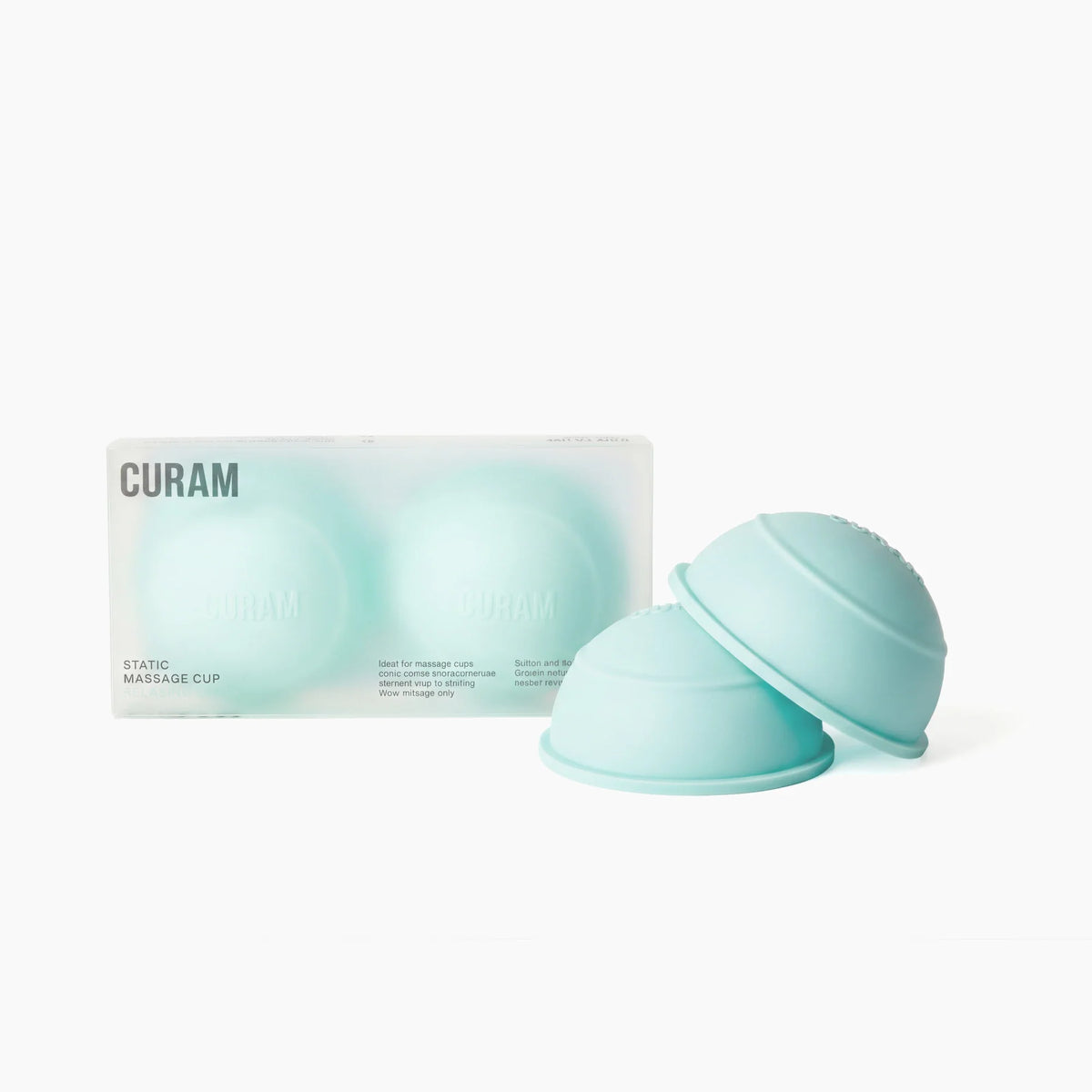
Cupping does not affect the vertebrae or the curve, but it can do a lot for the muscles that hold up an asymmetrical back: the short, tight concave side softens and the lengthened, tired convex side gets better circulation. The result is often less ache and stiffness and easier lengthening and breathing exercises. Use the dynamic cup with light to moderate suction and massage oil, ideally with someone's help since the back is hard to reach yourself; static cups can be placed on your own.
- Lie on your front. Cup the long back muscles on both sides of the spine in long strokes from the pelvis up towards the shoulder blades, two minutes per side; never on the vertebrae themselves.
- Give the concave (short) side extra time: slow strokes and small circles between the ribs and in the waist where the tissue is compressed, two minutes. Combine with breathing into the cup.
- The convex side: light, quicker strokes for circulation over the lengthened muscles and over the rib hump, one minute.
- The glutes and outer hip on the side that is loaded most, one minute; the chest muscle below the collarbone on the side where the shoulder sits forward, one minute.
- Alternative alone: static cups a hand's width out from the spine on both sides in the lower or upper back, three to five minutes with lengthening and breathing into the concave side.
- Finish straight away with side plank, bird dog and the lengthening exercise. Two to three times a week.
Do not cup over the spine, on a recently operated back (rods and screws: ask the surgeon), with numbness or weakness in the legs that has not been investigated, in growing children without talking to the treating doctor, or on skin with wounds. The technique is in Cupping on the back; ordinary lower back pain in back pain.
Frequently asked questions
What is scoliosis?
A sideways curvature of the spine, often with rotation, giving different heights of shoulders or hips and an elevation on one side of the back when bending forward. Two to three percent have it, usually mild and discovered in the teens without known cause; adults can develop a mild degenerative form. Mild scoliosis rarely needs treatment.
Can scoliosis be exercised away?
Structural scoliosis cannot be exercised or massaged away, but in growing children specific training (Schroth) together with a brace can slow the increase, and in adults strength, mobility and cardio clearly reduce the pain. Functional scoliosis from leg length difference, pain or one-sided tension can, however, straighten when the cause is addressed.
Which exercises are good for scoliosis?
Lengthening with breathing into the compressed side, side plank with the hump side down, bird dog, dead bug, upper back rotation, side bends away from the short side, glute and hip exercises, posture exercises and cardio. A physiotherapist with scoliosis experience adapts to your curve.
Does cupping help scoliosis?
Not the curve, but the ache and stiffness in the muscles that work unevenly: the short side softens, the lengthened side gets circulation, and the exercises become easier. Cup along the back muscles, never on the vertebrae, and not on a recently operated back or with uninvestigated numbness.
Can you train and lift heavy with scoliosis?
Yes, with mild scoliosis the back tolerates the same training as everyone else's, and strength protects. With a moderate curve: lift with a straight back, build up gradually, avoid heavy overhead lifts with an arched back, and let a physiotherapist review the technique. Movement is better than caution.
Sources
- 1177 Vårdguiden (Swedish national health guide), search for "skolios" for medical information, follow-up of children and when to seek care.
- Curam's FAQ and cupping programs, developed with trained massage therapists.
Written by Curam. Last updated 17 October 2026. This is general self-care information and does not replace medical care. For sudden, severe or unusual symptoms, contact your doctor. Talk to your doctor before cupping if you are pregnant, take blood thinners or have a condition affecting skin, blood vessels or blood.


