


Collagen is the body's most common protein, about a third of all the protein you have, and it forms the network of fibres that gives skin structure and spring, tendons and ligaments tensile strength, cartilage shock absorption and bone toughness. In the skin it is made by fibroblasts in the dermis, where collagen types I and III lie as a densely woven layer together with elastin and hyaluronic acid. From about the age of 25, new formation decreases by around one per cent a year, and at menopause women lose up to 30 per cent of the skin's collagen over five years as oestrogen falls. That is intrinsic ageing. Extrinsic ageing, which accounts for up to 80 per cent of the visible changes in the face, is UV radiation (which breaks down collagen directly and switches off new formation), smoking (lowers oxygenation and activates collagen-degrading enzymes), sugar (binds to the collagen and makes it stiff, glycation), air pollution, sleep deprivation and chronic stress. The result is thinner skin, fine lines that become wrinkles, less spring, and over time laxity. The good news is that fibroblasts remain able to form collagen throughout life, if they get the right signals and are spared the breakdown, and that several of those signals are free.
Three things called collagen
| Collagen you eat (powder, capsules, bone broth) | Collagen you apply (creams, serums) | Collagen the skin builds itself | |
|---|---|---|---|
| What happens | Broken down in the gut into amino acids and small peptides; some peptides appear able to signal to fibroblasts | The molecule is too big to pass the skin barrier; sits on the surface and binds moisture | Fibroblasts make new collagen in response to signals and mechanical load |
| Effect on the skin | Small but measurable increase in hydration and elasticity after 8–12 weeks in most studies; the effect on wrinkles small | Moisturising like any good moisturiser; no effect on the skin's own collagen | The only thing that gives a lasting difference in firmness and wrinkle depth |
| Conclusion | Can be tried, but not instead of the basics | Buy it for the moisture, not for the collagen | This is where the effort should go |
What actually increases the skin's collagen, in order of evidence
- Sun protection every day, all year. UV is the biggest collagen destroyer, and in studies where half the face was protected for years the difference in collagen and wrinkles is striking. SPF 30–50, broad spectrum, even on cloudy days and indoors by windows. This is not one of the measures; it is the precondition for all the others.
- Retinoids (tretinoin on prescription, adapalene, retinal, retinol) are the only topical proven in controlled studies to increase collagen type I in the skin, measured in biopsies, after six to twelve months of use. Start low, every other evening, build up; not in pregnancy.
- Vitamin C is necessary for fibroblasts to be able to build collagen at all (a cofactor in synthesis), and a stable serum with 10–15% L-ascorbic acid increases collagen in studies and protects against UV together with sunscreen. In the diet: fruit and vegetables, deficiency is uncommon but occurs.
- Protein in the diet, 1–1.2 grams per kilo of body weight a day, with the amino acids glycine, proline and lysine (meat, fish, eggs, dairy, legumes), plus zinc, copper and vitamin C. Collagen is built from what you eat; without enough protein no powder helps.
- Not smoking, including snus and vaping to a lesser degree: smokers have measurably less collagen and deeper wrinkles at the same age, and the breakdown stops within months of quitting.
- Sleep: growth hormone and the skin's repair peak during deep sleep; chronic sleep deprivation gives a measurably poorer barrier and elasticity. See deep sleep.
- Less sugar and fast carbohydrates: glycation binds sugar to collagen fibres and makes them stiff and yellowish; the effect is slow but accumulates.
- Mechanical stimulation: fibroblasts build collagen in response to pull and pressure (mechanotransduction). Microneedling and fractional laser at a skin therapist/dermatologist use controlled injury for that and have good evidence; facial massage, gua sha and face cupping give milder, repeated stimulation without injury, with increased blood flow and lymph flow, and have support in smaller studies for increased elasticity and skin thickness with regular use (see below).
- Oestrogen in menopause (systemic or local hormone therapy) slows collagen loss noticeably in those who can and want to use it; discuss with a doctor. See menopause.
- Peptides, niacinamide and growth factors in skincare have weaker but some evidence; niacinamide strengthens the barrier and reduces glycation, some peptides signal to fibroblasts. Reasonable complements, not the foundation.
Collagen powder and supplements: what research says
Hydrolysed collagen (collagen peptides) in doses of 2.5–10 grams a day has been studied in some twenty randomised trials on skin, and the reviews show small but statistically significant improvements in skin hydration and elasticity, and in some studies wrinkle depth, after eight to twelve weeks. The mechanism is thought to be that certain peptides (proline-hydroxyproline) survive digestion, are absorbed into the blood and signal to fibroblasts to build more. But: most studies are small, short, funded by manufacturers, and the effect is of the order of a few per cent better elasticity, not a visible change in the mirror. For joints (osteoarthritis, joint pain in athletes) there is similar moderate support for 10 grams a day for three to six months. Here is how to reason: if the basics above are in place and you want to try, choose hydrolysed collagen (peptides) from a company that discloses contents and third-party testing, 5–10 grams a day, take it with vitamin C, give it twelve weeks and photograph before and after in the same light; marine or bovine makes no certain difference, "type I and III" are the skin's types, "type II" is cartilage's, and vegan "collagen" is not collagen but building blocks and vitamins you can just as well get from food. Bone broth contains gelatin in varying amounts and is pleasant but not dosed. Collagen in gummies and drinks is often too low a dose to match the studies. And most importantly: no powder compensates for sun, smoking and sleep deprivation.
What is wasted money
- Creams "with collagen" bought for the collagen's sake: the molecule stays on the surface.
- Collagen powder without sun protection and protein in the diet: you don't build the house with one nail.
- "Collagen-boosting" treatments without a mechanism (crystal-clear devices, light at the wrong wavelength, expensive ampoules); ask what actually happens in the skin.
- Red light therapy has some evidence for collagen, but home devices are often too weak; see red light therapy.
- Starting expensive supplements at 50 but continuing to sunbathe without protection.
Face cupping, massage and collagen
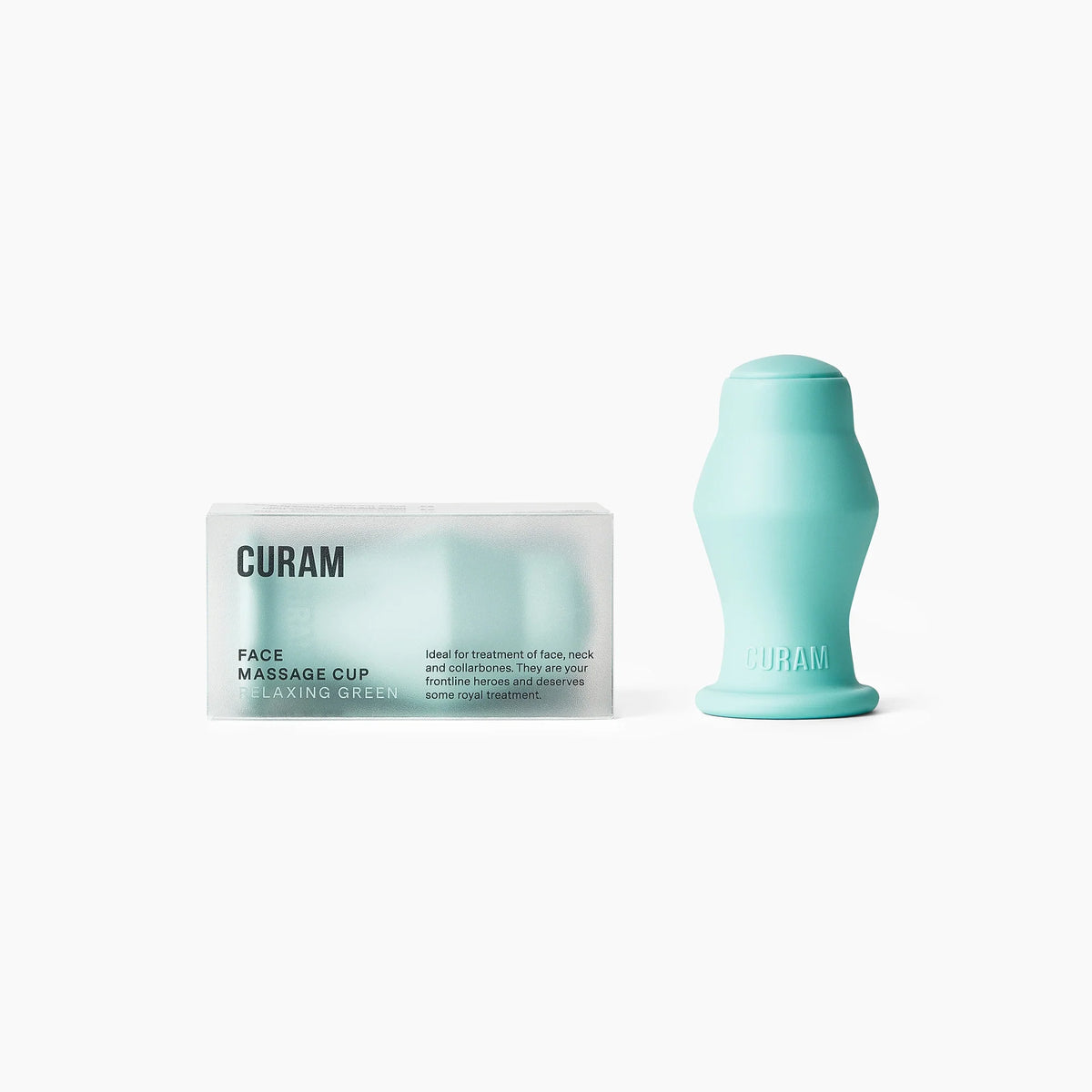
Mechanical stimulation of the skin is one of the proven routes to more collagen, and face cupping is a mild form of it: the suction lifts the skin and dermis from the underlying tissue, stretches the fibroblasts and connective tissue, and increases blood flow in the skin ten to twenty times for a few minutes, which gives the fibroblasts oxygen, nutrients and the mechanical signal to build. Small studies on vacuum massage and similar devices show increased skin thickness, elasticity and collagen density after eight to twelve weeks of regular use, and the immediate effect, glow and less puffiness, comes from circulation and lymph. It is reasonable to expect firmer and more even skin after two to three months with three sessions a week, not for wrinkles to disappear. And technique decides: it is light, repeated traction that stimulates; strong suction that causes redness, bruises or broken capillaries damages instead, especially on thin skin, and with rosacea, melasma and active acne special rules apply. How to do it for collagen: cleansed skin, a few drops of face oil, the face cup with light suction in slow strokes from the centre of the face outwards and upwards (chin towards ear, corner of the mouth towards ear, side of the nose towards temple, eyebrow towards hairline) and down along the neck, the mini cup around eyes and mouth with the lightest suction, five to ten minutes, three times a week; follow with retinoid or vitamin C and sunscreen the next morning, and the routines reinforce each other. The full technique in face cupping, results to expect in facial cupping before and after, and wrinkles specifically in wrinkles. For the body: cupping of thighs, belly and arms stimulates collagen and circulation in the skin the same way and is used for stretch marks and loose skin.
Read more
Wrinkles, skincare routine, face cupping, facial cupping before and after, pigment spots, stretch marks and loose skin, menopause and red light therapy.
Frequently asked questions
Does collagen powder help the skin?
A little: some twenty studies show small but measurable improvements in skin hydration and elasticity after eight to twelve weeks with 2.5–10 grams of hydrolysed collagen a day, mostly in manufacturer-funded studies, and the effect is a few per cent, not a visible change. It can be tried for twelve weeks if sun protection, retinoid, vitamin C, protein in the diet, sleep and not smoking are already in place, but not instead of them.
What increases collagen in the skin most?
Sun protection every day (UV is the biggest destroyer), retinoids (the only topical proven to increase collagen in biopsies), vitamin C serum, enough protein in the diet, not smoking, sleep, less sugar, and mechanical stimulation such as microneedling, massage and face cupping. Oestrogen in menopause slows the loss. Creams that contain collagen do nothing for the skin's own collagen.
Does collagen cream help?
As a moisturiser, yes; for the collagen, no. The collagen molecule is too big to pass the skin barrier and stays on the surface where it binds moisture. If you want to influence the skin's collagen with skincare, it is retinoids, vitamin C, niacinamide and certain peptides that have evidence, together with sun protection.
When do you start losing collagen?
From about the age of 25, new formation decreases by around one per cent a year, and at menopause women lose up to 30 per cent of the skin's collagen in five years. Sun, smoking, sugar, sleep deprivation and stress accelerate the breakdown much more than age itself: up to 80 per cent of the visible changes in the face are due to sun. Fibroblasts can form new collagen throughout life if they get the right signals.
Does face cupping increase collagen?
Mechanical stimulation is a proven route to more collagen, and face cupping gives a mild, repeated one together with greatly increased blood flow; small studies on vacuum massage show increased skin thickness and elasticity after eight to twelve weeks. Expect firmer and more even skin after two to three months with three sessions a week, not for wrinkles to disappear. Light suction and slow strokes outwards and upwards; strong suction damages the skin instead.
Written by Curam. Last updated 17 October 2026. This is general self-care information and does not replace medical care. For sudden, severe or unusual symptoms, contact your doctor. Talk to your doctor before cupping if you are pregnant, take blood thinners or have a condition affecting skin, blood vessels or blood.


