


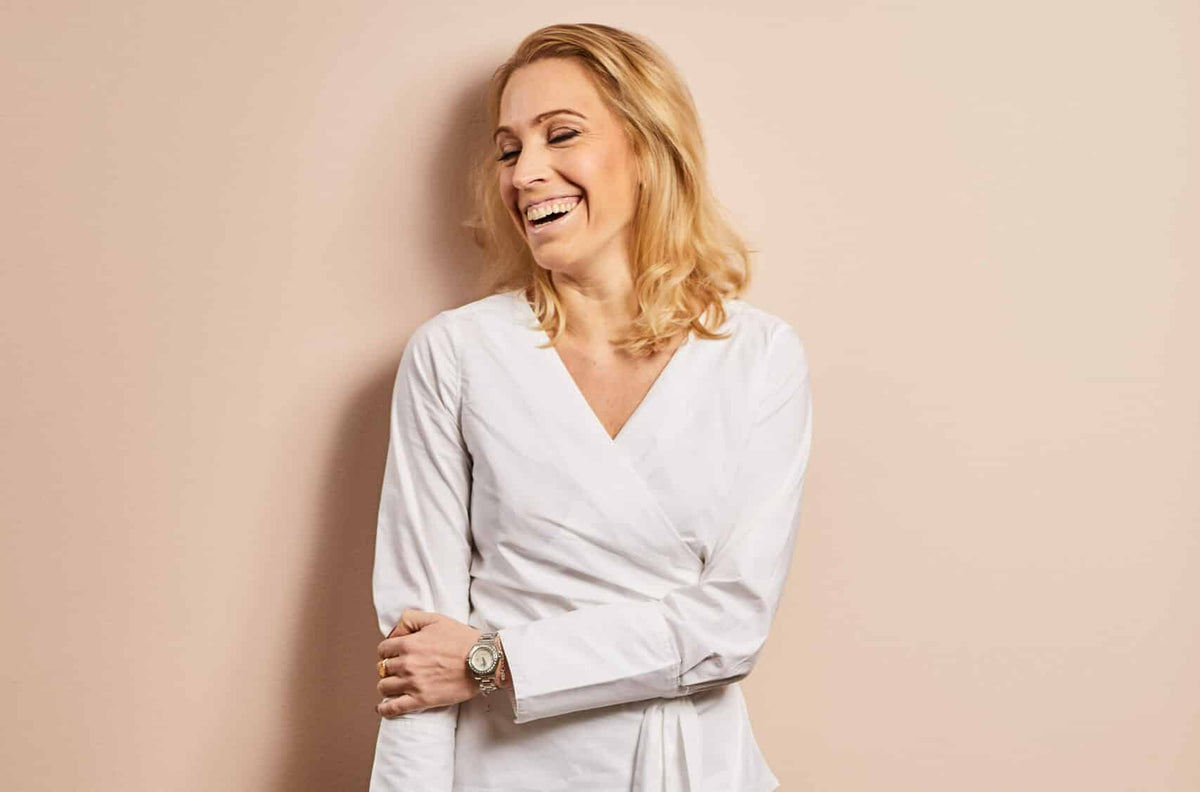
This interview was made in May 2023. Jenny's experiences and tips are just as relevant today.
Swedishyogagirl on Instagram, Jenny Kruseborn off it. Purchasing director, new mum and competing badminton player at elite level, with several gold medals from the Swedish and European veteran championships and her sights set on the Worlds. We met to hear how Jenny manages to fit it all in, and what tips she has for creating that famous, much longed-for balance.
Tell us, who is @swedishyogagirl?
Yes, who am I really? According to my nearest and dearest, a person who tries to see things positively when possible and who has solutions for most things. For better or worse, perhaps. I am a good listener and I have an enormous drive. To date I have worked around 15 years in the beauty industry, with 50–60-hour weeks, developing, building and marketing different brands. Alongside that I have kept up my badminton career, done yoga, run, gained four bonus children and had a child of my own. So it is fair to say that drive, focus and will have been needed over these years.
I launched my yoga account when my best friend Linda Voltaire and I were lying on sun loungers in Marbella with a glass of rosé in hand. We both felt, right there and then, that life was more than good! I thought it would be fun to start a yoga account, climbed onto the wall by the beach club and snapped my first pose. And that is how it started. The account has grown from mostly yoga to now including healthy food, other training and a few baby updates.
The plan going forward is to keep inspiring movement, but also recovery and enjoyment. It is all about balance. The goal is definitely to keep working on the balance between work and life in the coming years. Because are you ever done?
You have played and competed in badminton more or less all your life. What does it take to be a good badminton player?
It is a very complex sport, said to be the fastest in the world. You need fitness to play long and many matches. Tactics to read the game and your opponent. Technique to cope with the speed of the sport and to hit the difficult or decisive shots. And not least mental strength, something that is talked about and trained far too little, to handle nerves and pressure and keep your concentration through a whole match or tournament. That is one of the reasons I love the sport: it has so many parts. You can always develop a little more in some area.
How do you work with recovery to optimise your performance?
I drink water with electrolytes and take extra magnesium after harder training and competition. I drink a protein shake so the muscles do not break down. Then I try to use the infrared sauna once a week, and there I like to use Curam's massage cups on my calves and thighs to increase circulation. I use the cups above all after I have trained and competed a lot, to speed up and ease recovery. The dynamic cup is a favourite on the calves, which take a beating in badminton. It feels intense but is so nice afterwards. The static cups I place around the knee and on the shoulders.

It is also important for me to recover not just the body but the head. I try to take it a little easier with the to-do list in the days after a competition, meditate a little extra and happily take a longer walk where my thoughts can just fly.
Having a job that meant 60-hour weeks and then performing at badminton tournaments in my spare time has at times been extremely exhausting for both body and mind. Since I had my child I have started to take it a little easier. Being pregnant and on parental leave became something of a turning point: I was forced to stop, reflect and prioritise. I meditate more, compete less often and schedule more rest days. I still have some way to go to full balance, if you ever find it. But today I train more to feel good, alert and strong than purely to get better, stronger and faster.
What do your daily routines look like to feel as good as possible?
I always start the day with a cup of warm water with lemon, I never skip that. And I need an oat cappuccino to kick-start the body. I always eat breakfast, preferably a healthy one with good fats, fibre and protein. Banana pancakes with protein powder are a favourite, or crispbread with egg and avocado. I try to get outside for a while every day. When I was on parental leave I took a long walk almost every day, which felt so good. Just letting thoughts flow freely. There is no to-do list when you are out walking.
I try to fit in a little self-care every week: a hair mask, double shampooing, exfoliating, painting my nails. And I try to use the face cup once a week to boost circulation, wake up the lymph and simply add a little extra glow. You cannot get too much of that when you are constantly short of sleep. To stay present and focused I meditate three to four times a week.
Who inspires you?
My best friend Linda, who runs @yogawithasilverlining, inspires me to think differently and dare to follow my heart. We both agree that the years of 60-hour weeks were instructive and often fun, but there is more to live for than work. Health should always come first.
My partner is a great role model, and I would love to find a balance like his in the future. He has created a life where he has free time to do what he loves and be with the family, while also having a rewarding and fun job where he does not have to work himself to death. The dream!
What is the most challenging thing you have been through, and what did you learn from it?
I had quite a long period, a few years, where in hindsight I was probably heading into the famous wall. I worked all the time, and when I was not working I was competing in badminton, travelling with friends or out at something social. I got dizzy and nauseous several times a week, had panic attacks, difficulty breathing and could not sleep. I started avoiding social situations where I did not have any of my close ones with me. Now I wonder how I could live like that for so long. This went on for several years, and in many ways the pandemic was actually my rescue. When we started working from home I got more calm around me and more time with myself, and that was incredibly good for me and my health. Then came parental leave on top of that. Raising and spending time with a baby is more challenging than any job I have had, and almost around the clock too. But also wonderful, developing and a completely different kind of stress that suited me well right then. I got the chance to reflect and came to the conclusion that I want to feel better, have more energy, more time for family and friends and, perhaps most importantly, more time for me.
Jenny's recovery with cupping, step by step
- Calves and thighs after training: Curam Dynamic Cup with the body oil, slow strokes towards the back of the knee and the groin. Ideally in the sauna.
- Knees and shoulders: static cups left in place for a few minutes.
- The face once a week: Curam Face Cup for circulation, lymph flow and glow.
Want to do as Jenny does? Read Recovery after training – 5 tips and Cupping at home, step by step. Everything she uses is in the Complete Kit.


